


25 / 11 / 2026
Common Crawl: the web archive that feeds AI and that almost nobody audits

Bruno Díaz
—Marketing Manager
SectorLet's talk about
When a company asks why ChatGPT doesn't recommend it, the conversation usually turns to content, reviews or links. There is an earlier layer that almost nobody checks: whether the crawlers that collect data to train AI models can read the website. Common Crawl is the most relevant case, and checking it takes a few minutes.
What Common Crawl is
Common Crawl is a non-profit organisation that crawls the open web and publishes the results for free. Every month it collects more than 2 billion pages, and anyone can download them. Its crawler is called CCBot and it respects the robots.txt file and the nofollow attribute.
It isn't a search engine and it has no interface for looking up pages one by one. It's a raw data archive, built for researchers and tech companies that need to work with the web at scale.
Background: from a research project to the foundation of generative AI
Gil Elbaz founded Common Crawl in 2007. He had co-founded Applied Semantics, which Google bought in 2003 and whose technology ended up in AdSense. The archive holds crawls going back to 2008 and now exceeds 10 petabytes. Amazon Web Services started hosting it in 2012, which made it accessible to any team on a small budget.
For years its users were mostly researchers and startups. The shift came with large language models. A filtered version of Common Crawl made up around 60% of the weighted training data for GPT-3, and open datasets such as C4, RefinedWeb, RedPajama, Dolma, FineWeb and Nemotron-CC have been built from its crawls. The audit Mozilla published in 2024 concluded that 64% of the language models released between 2019 and 2023 had been trained, in one way or another, on Common Crawl data.
The organisation hasn't escaped controversy either. In November 2025, an investigation by The Atlantic questioned whether it respected paywalls and publishers' content removal requests, and Common Crawl responded publicly. For a company that wants visibility, the nuance is useful: some publishers block CCBot deliberately, and that's a legitimate decision.
Why it matters today for GEO
Classic SEO came down to getting indexed and ranking. With AI there are two more layers: training, which depends on the data the model read before release, and retrieval, which is when the assistant queries the web at the moment of the question. Common Crawl belongs to the first layer. The second involves each platform's own crawlers, such as GPTBot, OAI-SearchBot or ChatGPT-User in OpenAI's case.
That's why a website can perform well on Google and be almost invisible to AI. It happens when a firewall blocks CCBot, when content only loads with JavaScript or when the domain is poorly connected to the rest of the web. The AI Visibility Audit, the guide Common Crawl published in June 2026, argues that crawl access is the first step in any AI audit.
It's worth not overstating it. Being in Common Crawl doesn't guarantee appearing in ChatGPT, Gemini or Perplexity: each dataset filters content its own way, and the major labs stopped detailing what they train on some time ago. Blocking CCBot doesn't affect Google rankings either, because it isn't Googlebot. What does happen is that, if you're left out, you start at a disadvantage in a layer you can't make up for later.
How to check whether your website is in Common Crawl
The guide proposes five checks. The first three can be done from the command line in a few minutes.
1. Review your robots.txt. Look for rules that block CCBot or other AI crawlers.
curl -s https://yourdomain.com/robots.txt
Look for the string User-agent: CCBot followed by Disallow: /. Often nobody added it on purpose: it comes from a security plugin, a CDN or a robots.txt copied from another site.
2. Check the server's actual response. The robots.txt can be clean while the CDN or firewall still blocks CCBot before it reaches the site.
curl -A "CCBot/2.0" -I https://yourdomain.com/
curl -A "Mozilla/5.0" -I https://yourdomain.com/
If the browser gets a 200 and CCBot gets a 403, there's a block at CDN, WAF or bot management level.
3. Query the Common Crawl index. Having permission is one thing; having been crawled is another. The public index is at commoncrawl.org, where you'll find the list of available crawls.
curl "https://index.commoncrawl.org/CC-MAIN-2026-21-index?url=yourdomain.com/*&output=json" | head
Replace the crawl ID with the most recent one. Check whether the domain appears, how many URLs there are, which capture is the latest, and whether only the homepage shows up or also services, categories and blog posts.
4. Use a tool that automates it. At La Teva Web we use the Common Crawl Visibility Checker by Suganthan Mohanadasan. It's free, requires no sign-up and reads Common Crawl's files directly. It shows how many pages each of the last twelve monthly crawls captured, the robots.txt history (including the month a block appeared) and a live access test as CCBot, which detects firewall blocks that robots.txt doesn't reveal.
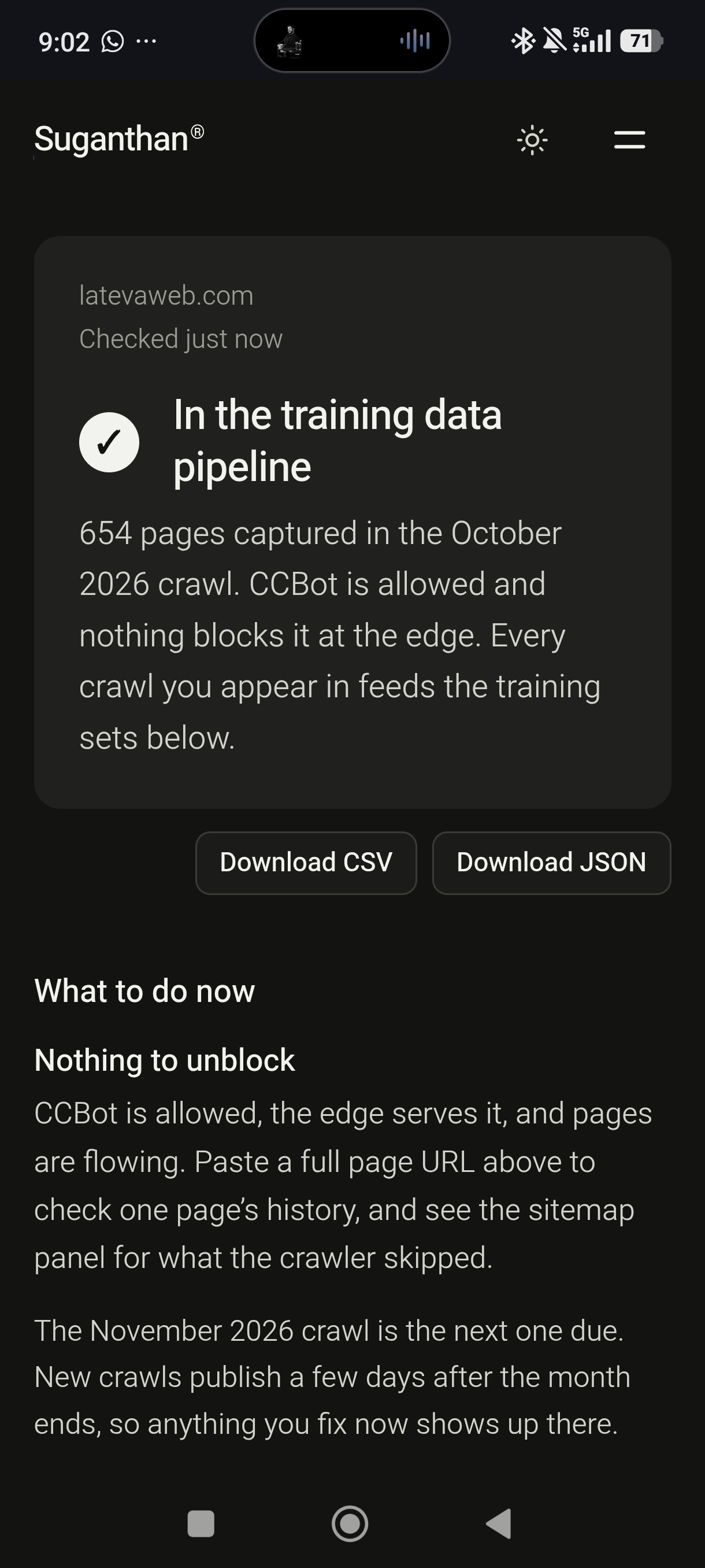
As a complement, the AI Crawler Access Checker on the same site tests access for GPTBot, ClaudeBot and PerplexityBot, and the open-source CLI squirrelscan includes a rule that checks for presence in the Wayback Machine and Common Crawl.
5. Look at your domain's centrality. Common Crawl prioritises what it crawls according to the web's link graph, measured by harmonic centrality. The closer a domain is to the core of the web, the more often and more deeply it tends to be crawled. The community tool metehan.ai, built on Common Crawl's graph data, helps you get an idea. It isn't an official product and shouldn't be read as a new “domain authority”.
One detail before blocking anything: any bot can claim to be CCBot. To verify a request is genuine, the reverse IP lookup must point to a .crawl.commoncrawl.org domain name that, in turn, resolves to the same IP. Common Crawl also publishes its IP ranges at index.commoncrawl.org/ccbot.json.
What to do to get crawled more and better
Common Crawl decides what to crawl based on how well connected and accessible a website is, so there's no switch that forces it to include you. There is, however, concrete work that makes a difference:
- Unblock CCBot if you don't want to be left out. Review robots.txt, your CDN settings (for example, Cloudflare's AI bot blocking option), the firewall and security plugins. The decision should be yours, not a default setting's.
- Put important content in the initial HTML. If a crawler doesn't execute JavaScript, it will only see the page skeleton. You can check with curl -s URL | grep -i "page headline". If the text doesn't show up, you need server-side rendering, static generation or prerendering.
- Look after internal linking. Orphan or deeply buried pages are the first to be left out. Key services, locations and articles should be a few clicks from the homepage.
- Earn links and mentions from well-connected websites. Mentions in media, associations, industry directories and partner sites matter more than a volume of links without context.
- Keep canonical URLs clean. If what shows up in the index is URLs with parameters or addresses from an old version of the site, the crawl is being spent in the wrong place.
- Complete your structured data. Organization or LocalBusiness, Article, Service, authors and sameAs links help machines understand who you are and what you do once they've read you.
- Repeat the review every quarter and after any change of CDN, hosting, CMS or security plugins.
When it makes sense to block it
Some publishers, creators and companies with paid content or legal objections prefer to stay out of training datasets, and that's a defensible position. For most service businesses, online shops and local businesses it's the opposite: they want an AI to know them when someone asks who can build them a website, run a campaign or provide a service. In both cases the check is the same. You need to know what's really happening and make sure the technical setup does what the company wants it to do.
Where to start
Spend ten minutes running your domain through Suganthan's tool and repeating the curl tests with CCBot and a browser. If a block shows up that nobody remembers enabling, you've already found the first improvement. If you'd like us to review it with you, at La Teva Web we include this layer in our GEO audits, along with AI crawler access, rendering and structured data.
About the author
Bruno Díaz — Marketing Manager
Professional with a long career as a communication and digital marketing consultant, specializing in SEO, SEM and web projects. As Marketing Manager of the agency, I coordinate a great team of digital marketing technicians of which I am very proud.
Related news


Hello! drop us a line
Being in Common Crawl doesn’t guarantee an AI will recommend you, but not being there can leave you out of the conversation before it starts.