


Updated: 17 / 02 / 2024
About Google and its semantic understanding

Bruno Díaz
—Marketing Manager
SectorLet's talk about
Google’s goal has always been to deliver the best possible results for a user’s search. Over time, it has improved semantic understanding, allowing it to better interpret both the user’s search intent and the content of websites. With the improvements Google has applied through its algorithms, SEO practices have also evolved. In the past, to rank a medium-difficulty keyword, it was enough to apply some on-page SEO, do a lot of keyword stuffing, get a link or two (or even none), and success was almost guaranteed. Today this is not only insufficient, but directly against several of Google’s guidelines for ranking in its search engine.
Nowadays, when we perform a search, Google considers hundreds of factors: our search intent, browsing history, geolocation, the language used, related entities, trending topics, and many more parameters. As a result, it returns a results page that may include blue links but also many other types of content.
Summary of contents:
NLP and its role in algorithms and results
NLP stands for Natural Language Processing. Applied to SEO, you must understand that Google uses it to better understand user search intent and website content to match both sides. When we type a query into the search engine, Google performs a semantic analysis, detects relationships between words, and obtains a combined meaning of the search along with related entities. Google also uses this to understand and relate information about current events, news, or even conversations in forums and social networks.
Tokenization is a key process in understanding how NLP works in Google: it refers to how Google splits text into individual words, analyzes them separately and together, and considers punctuation.
Another key step is grammatical categorization. Like when we analyzed sentences in school—breaking them down into subjects, verbs, objects, modifiers—Google tags nouns, verbs, adverbs, prepositions, and interprets the nuance each contributes.
Another essential layer is lemmatization. This process transforms words into their dictionary form. For example, “finalizado” becomes “finalizar.” If we search for “posicionamiento SEO,” lemmatization may return “posicionamiento en buscadores” as a more precise match: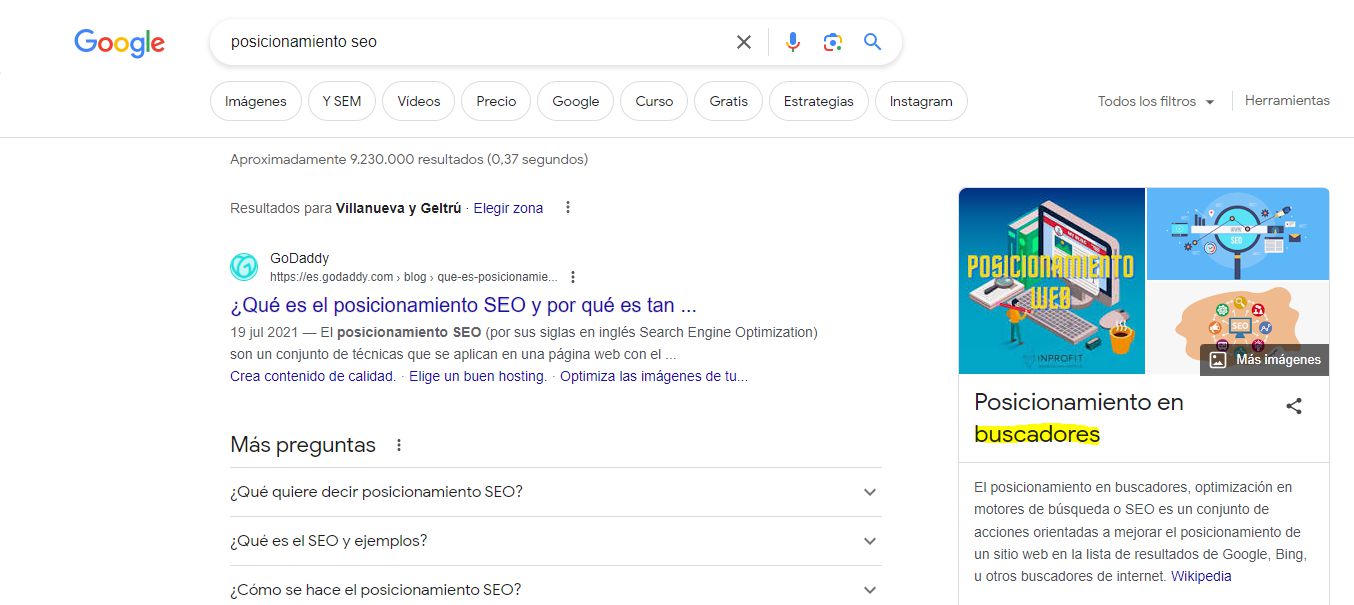
Next, we have dependencies: Google must understand which words depend on others grammatically. If I say “this post is very good,” Google must understand that “good” modifies “post,” not the previous word—as used to happen years ago.
NLP, Entities and the Knowledge Graph
All of this ties into a concept we already know: the Knowledge Graph. These special search results rely heavily on entities, which are unambiguous objects or concepts. For searches related to “Barcelona,” one entity is the city, but another equally prominent one is the football club:

If we add a qualifier, Google distinguishes the entity and adjusts the results:
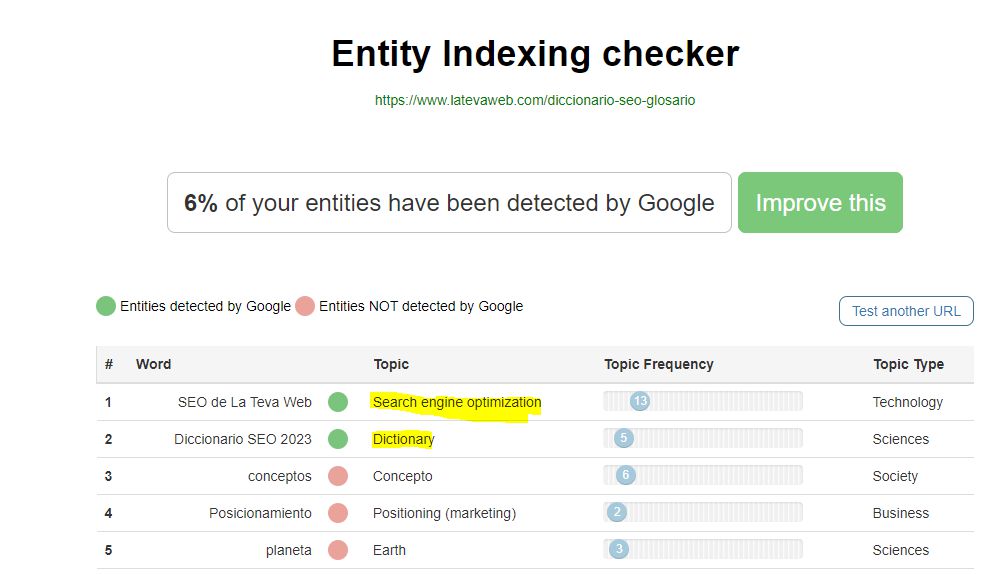
If you want to see which entities a text is associated with, you can use the Inlinks entity indexing checker. For example, analyzing our SEO dictionary returns:
Google’s NLP API
A powerful tool—free up to a certain usage limit—is Cloud Natural Language. You can input text, and the system shows how Google analyzes it and which entities it extracts. Example using our post about Open Graph: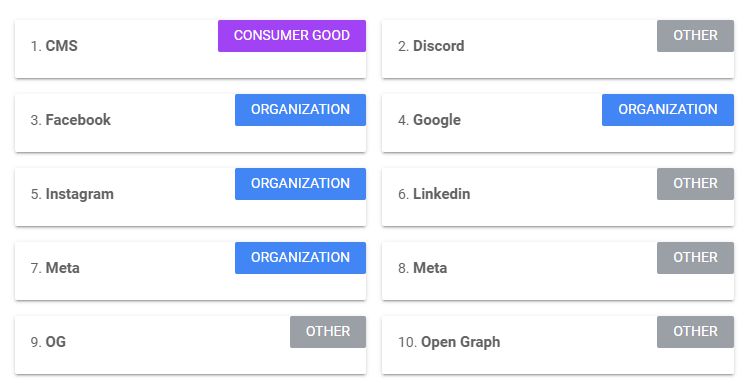
How Google interprets semantics
Google analyzes the query and then decides which results to show. To do this, it analyzes the content of each URL and the link signals it receives—internal and external.
HTML and the DOM
Googlebot first scans the HTML. If you use Javascript-heavy websites, be cautious: what the user sees may not appear in the raw HTML. Later Google processes the rendered DOM. It’s best if key content already appears in the initial HTML.
Anchoring and semantics
Anchor texts help Google interpret what a URL is about. Avoid anchors like “here,” “more,” etc. The link should be contextual, and ideally from a site with related topical relevance.
Other factors Google considers
- Relationship between content and entities
- EEAT guidelines
- Schema markup
- Social signals
- The topical classification of your domain (a site about SEO will rank easier for SEO topics than for ornithology)
How to align content with specific searches
We don’t aim to rank “just because.” Ideally, each URL should target one primary keyword. Macro-content may still work, but mainly as a hub to distribute internal links.
- Optimizing title, description, URL and image ALT attributes
- Proper heading hierarchy
- Balanced use of keywords, related concepts and entities
- Internal linking strategy
- External linking from thematically related domains
Semantic analysis of content
There are several methodologies: keyword density, prominence, co-occurrence, TF-IDF, etc. The goal is simple: Google must clearly understand what your content is about without forcing unnatural repetition.


About the author
Bruno Díaz — Marketing Manager
Professional with a long career as a communication and digital marketing consultant, specializing in SEO, SEM and web projects. As Marketing Manager of the agency, I coordinate a great team of digital marketing technicians of which I am very proud.
Related news

Hello! drop us a line
Understand how Google deciphers and interprets your site’s content to give your SEO a boost.