


Updated: 04 / 03 / 2026
How to appear in Google AI Overviews?

Francesc Sánchez
—Digital marketing expert
SectorLet's talk about
Google AI Overviews or AIO are AI-generated summaries that appear above the organic results and answer a query with a synthesis built from multiple sources, including links to the cited pages. They are essentially an AI-based response to the user’s search.
The rollout of AI-based results in Google Search dates back to 2023, when the company announced it was working on the Search Generative Experience (SGE), which aimed to transform online search. However, it was not until May 14, 2024 that it officially launched in the United States under the name Google AI Overviews. Since then, the rollout has been iterative, with frequent changes. In terms of milestones, Google moved from SERP testing to a global expansion across more than 100 countries and territories (with multilingual support, including Spanish), and later evolved toward deeper conversational experiences with AI Mode.
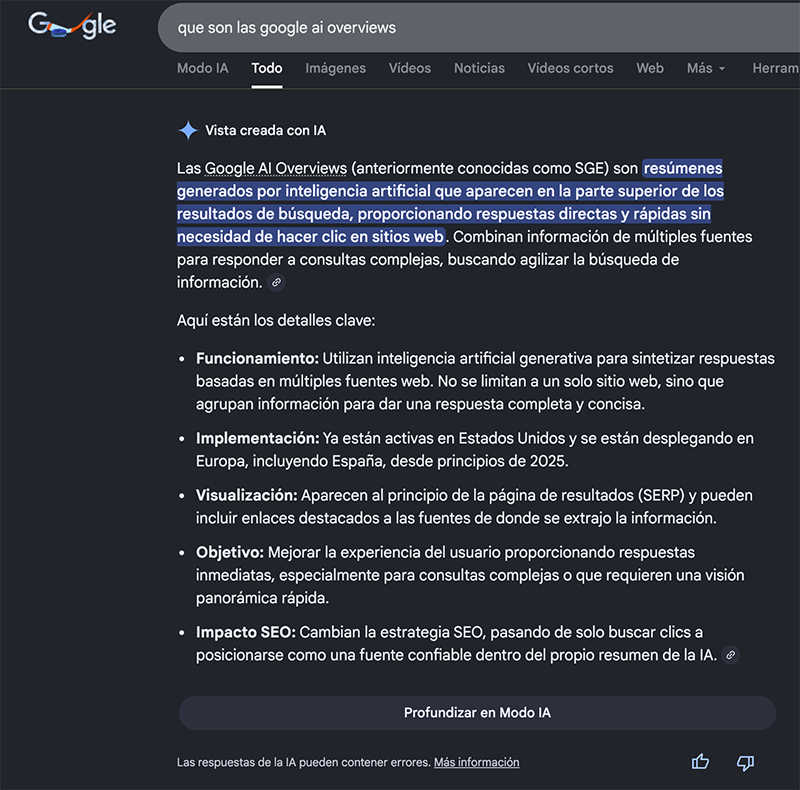
In addition, since January 2026 users can expand the summary and ask a follow-up question, allowing Google to move them directly into AI Mode without leaving the Google environment.
Table of Contents
How do Google AI Overviews work?
Conceptually, AI Overviews rely on a retrieval-augmented generation (RAG) approach: instead of answering only with “pretrained” knowledge, they retrieve information from the index and use it to build the response.
The process begins with the user’s search. Google interprets intent and context, retrieves relevant documents from its index along with associated signals, and passes them to Gemini’s LLMs, which generate a summarized response. Google also indicates and links to the sources used so users can verify or expand on the answer.
This mechanism creates two direct effects. The first changes SEO rules: search no longer simply displays a list of links but provides a synthesized answer within Google, built from multiple cited pages. SEO now adds a new objective: ensuring our web pages become part of those reference sources.
The second effect follows from the first: who loses? Site owners who depend on SEO to capture traffic. We now compete for a smaller visible space in Search. Our results move further from the top, and we no longer compete only with other organic results, paid listings, and Google Maps, but also with Google AI Overviews, which occupy the most prominent position in Search.
What is zero click and why AI Overviews accelerate it
Zero click is a simple concept: it occurs when a user searches on Google and gets the answer without clicking on any external result, meaning they never leave Google, something Google favors. A user can resolve their query through featured snippets, knowledge panels, maps, carousels, “Top stories,” or now Google AI Overviews. The result is that Google answers the user while we lose the website visit. By design and placement, Google AI Overviews accelerate zero click, as they provide a complete answer at the top of the page and push the organic list further down.
When Google AI Overviews are triggered
Google AI Overviews do not appear for every search. They usually trigger for informational searches, especially queries where users seek quick understanding. These are searches that can be resolved with a summary, definition, list of steps, or general comparison, such as:
- what is X
- how does X work
- differences between X and Y
- examples of X
- advantages and disadvantages of X
By contrast, in transactional searches (for example, buying a product or hiring a service), users need to perform an action that a summary does not fully satisfy: compare specific prices, check availability, review conditions, choose variants, purchase, book, or contact. In other words, AI Overviews compete with the click when users seek to understand and compete less when users seek to act, buy, or hire. Therefore, if you run a digital media outlet, an affiliate business, or a content-driven business, AI Overviews will negatively impact you. In contrast, service companies or e-commerce businesses may maintain revenue with fewer visits, reducing what we consider “learning traffic.”
We have explained why many websites are losing traffic even when ranking first on Google, but how many visits are being lost? According to Ahrefs, with data from December 2025, the decline is significant. When a keyword triggers Google AI Overviews, clicks on the first organic result in the SERPs drop by an average of 58%, compared to 35% in March 2025 according to Ahrefs’ AI Overviews Report. Seer Interactive, in its study “AIO impact on CTR, OCT’25,” raises the CTR drop to 65%, although it adds an important nuance: if your page is cited as a source, the reduction drops to 49%. This situation will intensify, as Google makes it easier for users to move from Google AI Overviews to Google AI Mode, which already functions like a classic AI chat.
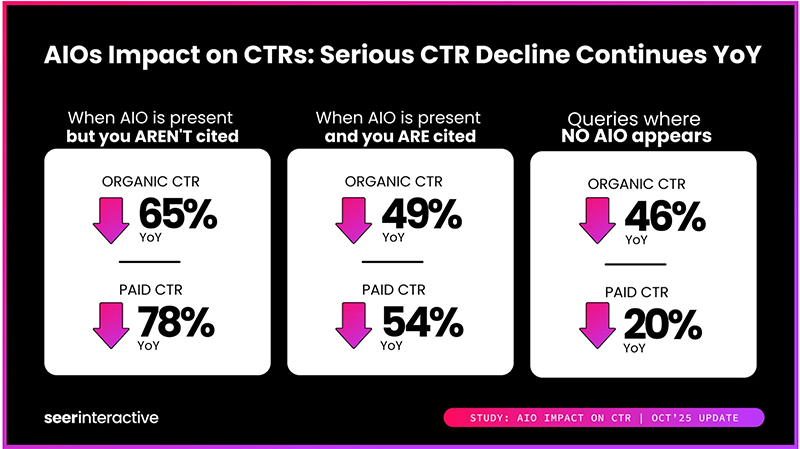
Source: AIO impact on CTR, OCT'25 Seer Interactive
For this reason, in 2026 SEO agencies and, particularly, AI SEO (GEO) agencies do not focus only on improving first-page rankings. We must reorient SEO strategy toward:
- Measuring real business impact (leads and sales) rather than visits, separating volume from value.
- Accepting that some informational traffic will decline while improving conversion from remaining visits.
- Strengthening commercial and decision-intent content.
- Continuing to work on SEO to rank in top positions.
- Working to appear as a source in Google AI Overviews and AI systems in general, known as GEO. Traditional SEO aims to rank pages in search results; GEO goes further by ensuring a brand or content becomes part of an AI-generated answer, not necessarily driving traffic but being directly cited or referenced.
How to appear in Google AI Overviews
To appear in AI Overviews, Google must be able to generate an answer from your page’s content, the page must rank for the query, and Google must trust your answer and recognize your authority. To appear in Overviews, strengthen these three factors. As with everything in SEO, it requires sound execution.
Essential: do SEO
To stand out in AI Overviews we must keep in mind that Google prioritizes well-ranked results as sources of information. Therefore, visibility in summaries and assistants does not replace technical SEO; it requires it. To compete for visibility in AI Overviews you should prioritize performance and stability, accessible HTML with content visible to bots, coherent internal linking, a clean heading structure, and structured data that adds clarity and remains consistent with the actual content. By the way, although well-ranked results in the SERPs are more likely to appear in AI Overviews, this is not the case in Google’s AI Mode.
Several recent studies from Ahrefs indicate that ranking well on Google still increases the chances of appearing in AI Overviews, although the weight of organic ranking is lower than before, in line with the expansion of Google’s AI Mode. This shift coincides with the adoption of Gemini 3 as the main model used to generate AI Overviews. In July 2025 it was estimated that 76% of citations came from pages ranked in Google’s top 10. In March 2026 that percentage dropped to 38%, according to an Ahrefs analysis based on 1.9 million citations. The study also shows that 31% of sources rank between positions 11 and 100, while another 31% do not appear within the top 100 organic results (source: Ahrefs). This clearly suggests that the system prioritizes topical authority and the ability to provide clear information about the query, beyond the simple position in the SERP.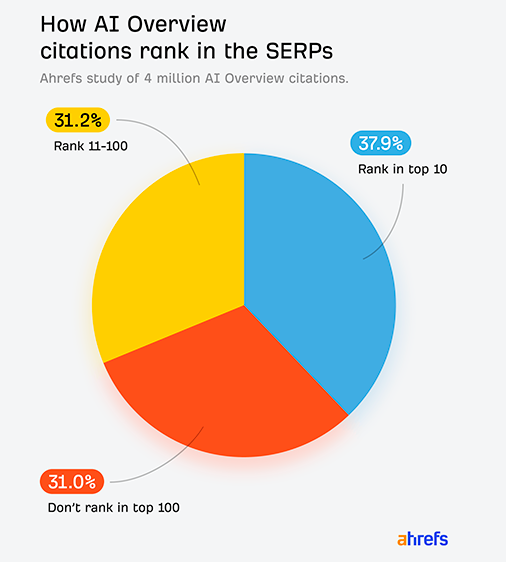
Informational clusters and fragment extraction
As explained, AI Overviews mainly trigger for informational and long-tail queries, and less often for branded, local, or short searches. Prioritize creating informational clusters and optimize content for extraction and citation. Google needs fragments it can integrate into a synthesis without losing precision. Typically, Google extracts only part of the content, known as grounding, meaning it links sources within the summary to support the response.
To facilitate extraction or grounding, divide each article into “response units” or “fragments.” For example, structure each URL into units such as:
- thesis: direct answer in 2–4 lines
- operational definition: what it is, what it is not
- criteria: how to evaluate options
- procedure: steps, conditions, limits
- evidence: data, examples, sources when relevant
- closing: conclusion and next step
Question-and-answer formats perform well in AI Overviews. Use FAQ formats and question-based headings. For example, a post titled “What is web design?” is more likely to trigger AI Overviews than one simply titled “Web design.” Searching “web design” may not trigger AI Overviews, but asking it as a question often will.
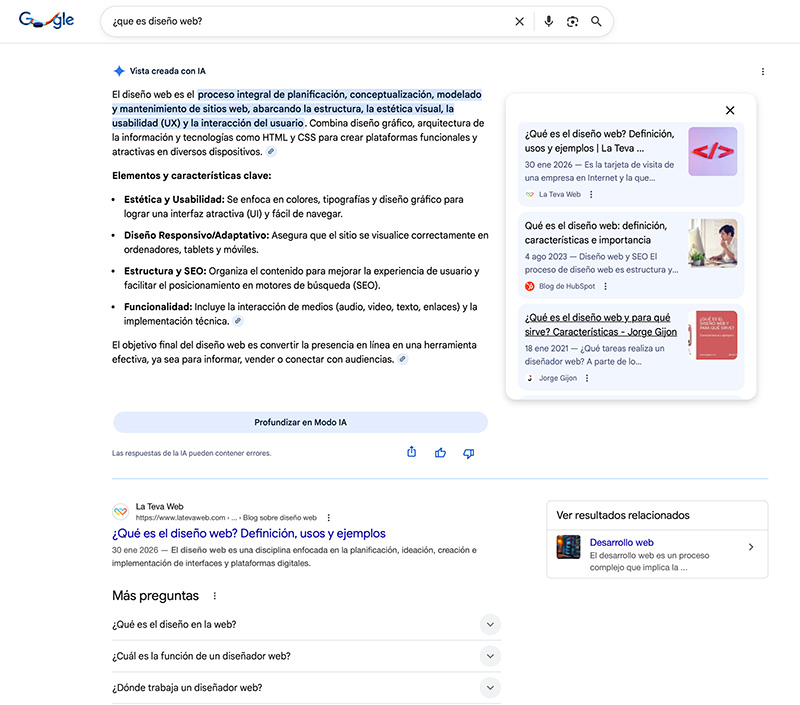
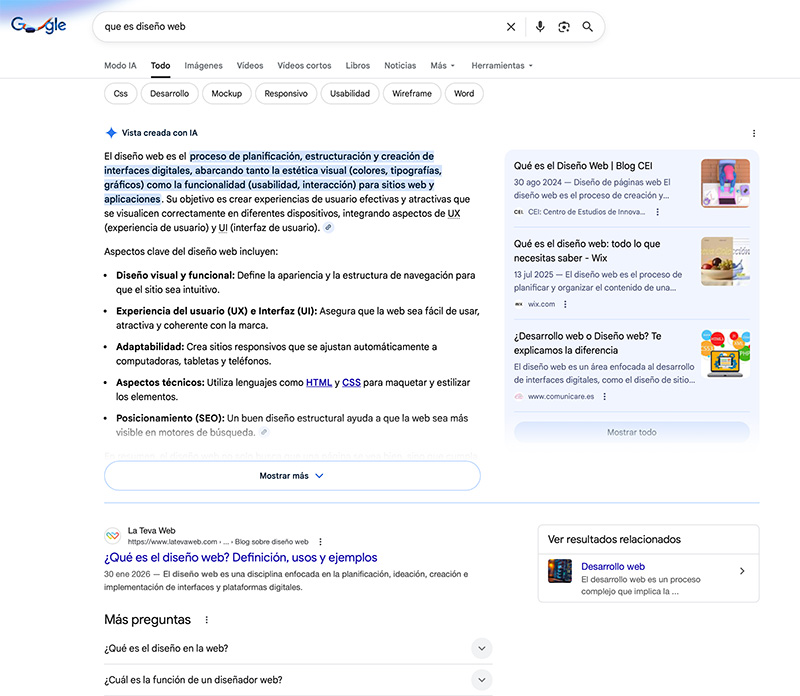
This leads to topical clusters. Google prioritizes sources that consistently cover a topic. It is easier to appear if your site publishes multiple pieces on a topic rather than a single well-written article. Choose a pillar page that defines the topic, create satellite URLs addressing sub-questions (one intent per URL), and link satellite URLs to the pillar page and to each other when they share criteria.
Technically, ensure accessibility to Google AI Overviews with crawlable HTML (avoid content hidden by .js), clear semantic structures (proper H2/H3 use aligned with intent, lists only when useful), structured data aligned with real content, and strong page speed and accessibility.
Authority and PR
A significant share of mentions concentrates among a limited number of domains, reinforcing the importance of authority and site reputation. The stronger your brand reputation, the higher the probability of appearing in AI Overviews. Your website competes with others, but your brand competes as an entity. When Google detects that an entity consistently appears in relevant contexts, it treats it as an authoritative entity and more easily selects it as a reference. In practice, this connects SEO with digital PR. Strengthen:
- original studies others can cite
- participation in market comparisons
- mentions in industry media and communities
- useful assets (templates, checklists, tools) that earn links through utility
Always apply EEAT to your entity and website.
Finally, the data from the Ahrefs study mentioned above also show that AI Overviews tend to cite certain types of platforms more frequently. Wikipedia stands out as one of the most commonly used sources due to its clear informational structure and strong topical authority. YouTube also appears regularly, reflecting the growing role of audiovisual content in the answers generated by Google. Reddit and Quora are also leveraged to help contextualize certain searches. As a result, Google does not rely only on corporate websites or media outlets, but also on knowledge repositories and communities where relevant information about a topic is generated.
Fresh and relevant content
When Google detects that a topic requires updated information, it tends to promote pages that were recently published or updated, signaling direct relevance to the user’s query. In SEO, this is known as "query deserves freshness", helping newer content maintain or improve rankings against older versions.
Ahrefs analyzed 17 million citations by channel and compared days since publication versus days since last update. Results show that Gemini, Copilot, and ChatGPT cite more recent pages than Google AI Overviews and the organic SERP. Google AI Overviews also prioritize recent content, like traditional SERPs, but show less bias toward freshness than Gemini, ChatGPT, or Copilot, where content may be up to 25.7% more recent than in traditional organic results and Google AI Overviews.
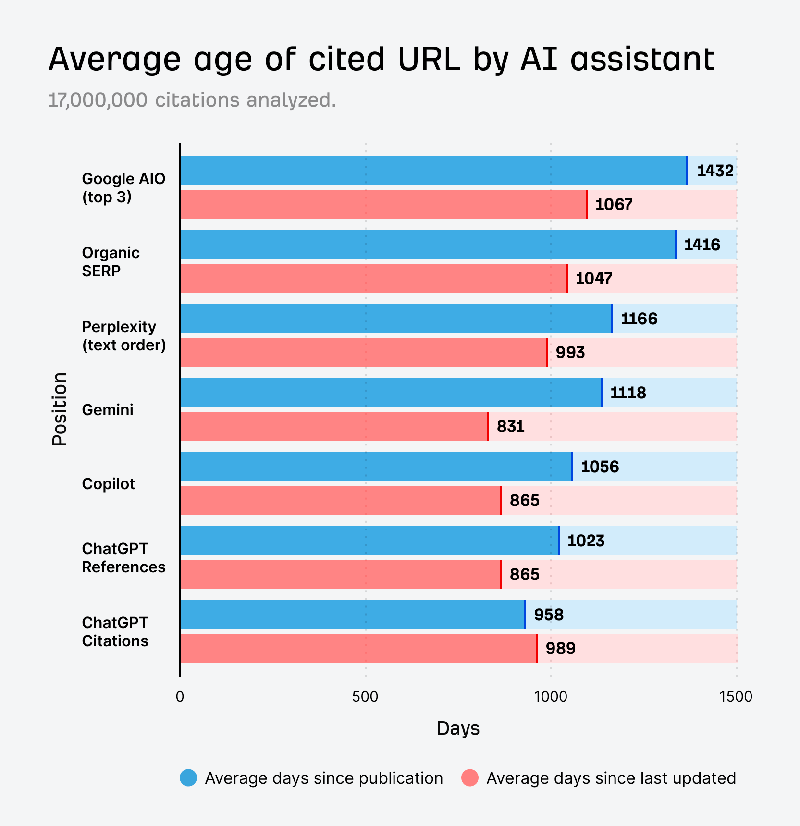
Legend: Fresh Content—Why Publish Dates Make or Break Rankings and AI Visibility by Ahrefs
AI Overviews prioritize recent and updated content and are more demanding than traditional SERPs. Simply making minor edits and changing the date is not enough. Apply real updates to improve traditional rankings and increase the probability of appearing in AI-generated answer blocks.
About the author
Francesc Sánchez — Digital marketing expert
From Barcelona, expert in digital marketing. Founder and CEO of La Teva Web and launcher of our magnificent blog. I am pleased to have laid the first stone of the foundations that support our values: happy customers and projects that leave their mark.
Related news

Francesc Sánchez


Hello! drop us a line
Google AI Overviews work by generating answers from multiple sources, using a retrieval-augmented generation (RAG) approach.