


30 / 09 / 2026
Legal guarantee notice for online stores: now mandatory

Bruno Díaz
—Marketing Manager
SectorLet's talk about
From 27 September 2026, any store that sells products to consumers in the EU must display a standardised European notice about the legal guarantee. If you have an eCommerce and you haven't checked it yet, it's a good idea to do so now.
What's changed
Implementing Regulation (EU) 2025/1960 lays down the design and content of a harmonised notice on the legal assurance of conformity, in application of Directive (EU) 2024/825. Neither the directive nor the regulation provides for a transitional period, so the requirements apply from day one.
The notice reminds the consumer that they have a legal warranty of at least two years. In Spain, the legal warranty on new goods is three years from January 1, 2022, so the rights in rem do not change: they are only made visible before purchase.
The notice does not create new rights: it makes visible, before the purchase, those that the consumer already has.
Who is affected?
To any seller of goods to consumers (B2C): own store, marketplace or physical store, whatever the sector or size. B2B sales and services are excluded. If the business is mixed, the obligation applies to the consumer sales part.
What needs to be implemented
- Download the official notice of the European Commission in the language of each version of the website.
- Publish it in color and without any modification. The elements of the notice are not editable.
- Create your own page with the notice and a "legal guarantee" link in the footer.
- Reinforce visibility with a link on the product sheet or at checkout. The rule requires that the notice be highlighted before the purchase, and a link only in the footer may fall short.
- Check that the conditions of sale do not present the legal guarantee as an advantage of the store. Presenting a legal right as if it were an offer from the seller is an unfair practice in all circumstances.
The GARAN label is a different element. It is only required for products with a specific commercial guarantee of durability, which is offered by the manufacturer, and most stores do not fall into that scenario.
How to do it on your platform
In WooCommerce or Shopify, all you need is a content page, the official image, and an entry in the footer menu. What usually takes more work is having the right version for each language and deciding where to strengthen the link within the checkout process.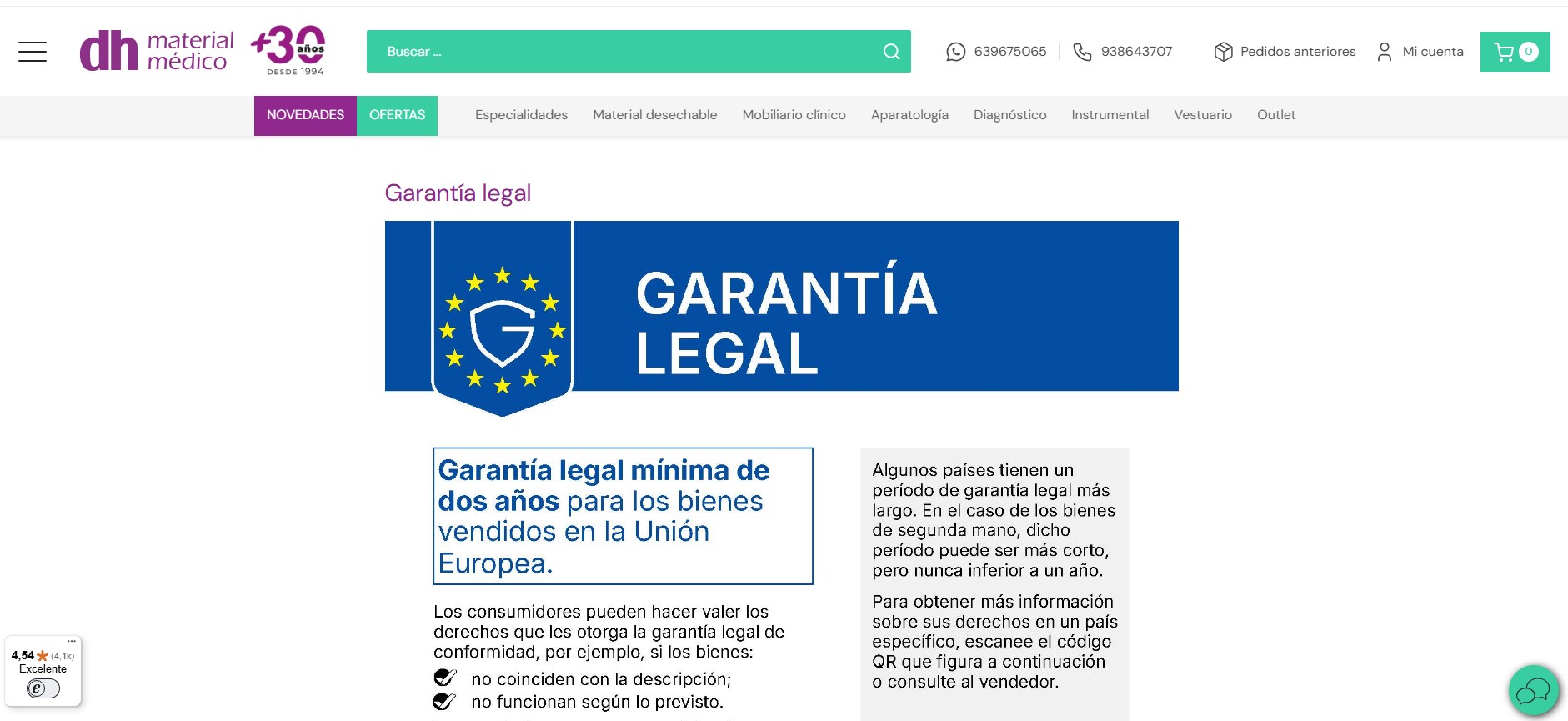
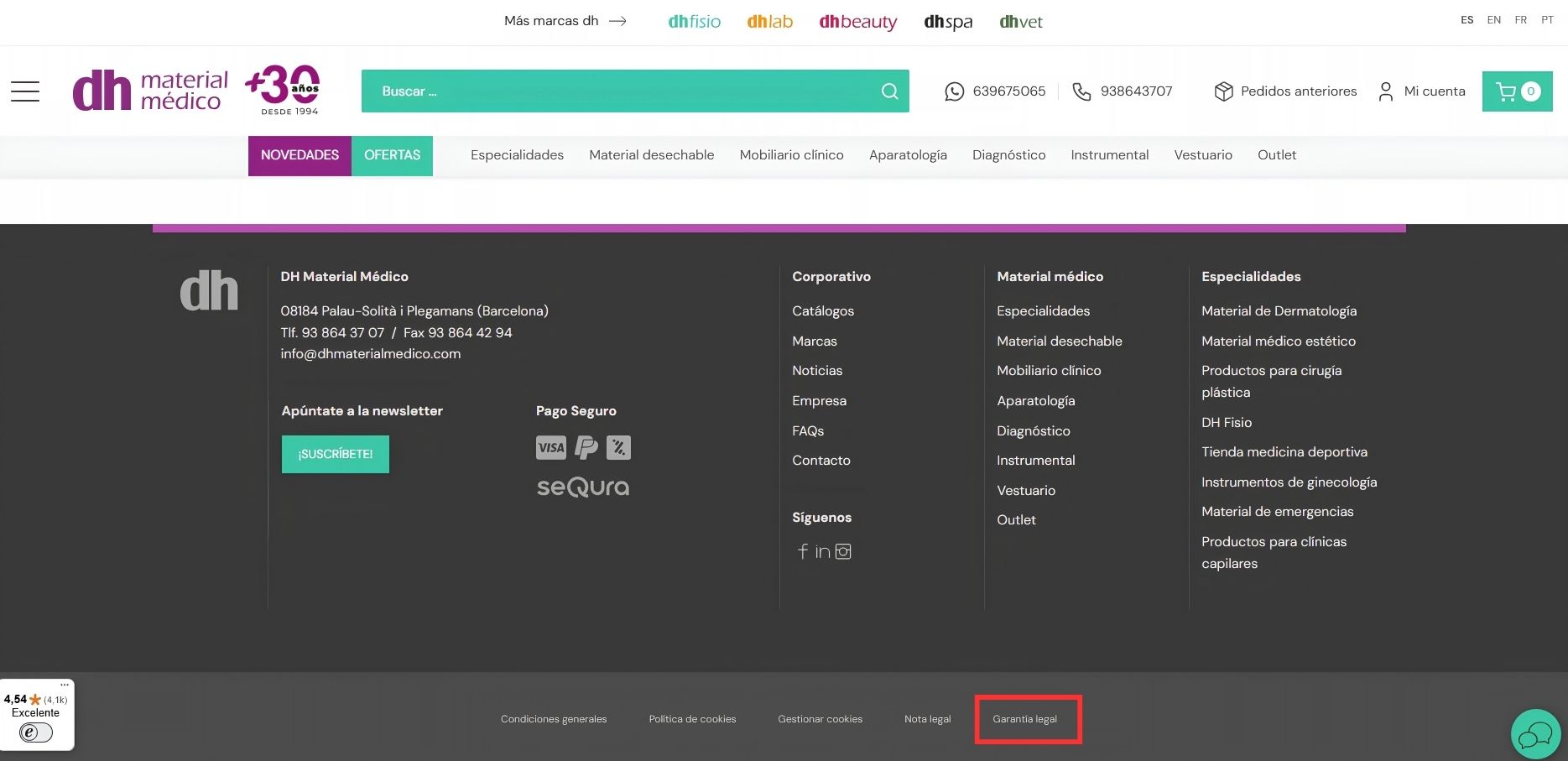
A real example is the DH Medical store, which we adapted. There is a "Legal Guarantee" link in the footer, next to the legal notice and the general conditions. It leads to its own page that shows the official notice in color and unmodified, with the QR code of the European Commission included. The store is in four languages and each version has its page with the corresponding image: Spanish, English, French and Portuguese.
Here is an example of how it should look in the footer
Possible sanctions
Non-compliance is considered a consumer offence, and the authorities can sanction businesses that fail to notice. In Spain, the TRLGDCU regime applies, with fines ranging up to €10,000 for minor infringements, up to €100,000 for serious infringements and up to €1,000,000 for very serious infringements. The graduation depends on factors such as recidivism, sales volume or the number of consumers affected.
The inspection corresponds to the autonomous communities; in Catalonia, to the Catalan Consumer Agency. Beyond the fine, there is a risk of consumer complaints and reputational damage.
What we recommend
The cost of adapting is low compared to the exhibition. A single review of the entire store is needed: languages, footer, product sheet, checkout and sales conditions.
At La Teva Web we have been updating our clients' online stores and we can review yours or coordinate with your developer. Write to us and we will see it.
Frequently Asked Questions
Is the legal warranty notice also mandatory for marketplaces?
Yes. The obligation falls on any seller of goods to consumers (B2C), including those who sell through marketplaces.
Can I modify the design of the official notice?
No. Implementing Regulation (EU) 2025/1960 provides that the notice must be published in colour and without any modifications. The elements of the notice are not editable.
Since when is the European legal guarantee notice mandatory?
From 27 September 2026. There is no transitional period: the requirements apply from the first day of entry into force.
Does it also affect B2B sales?
No. The obligation applies exclusively to sales to consumers (B2C). Business-to-business sales and services fall outside the scope.
About the author
Bruno Díaz — Marketing Manager
Professional with a long career as a communication and digital marketing consultant, specializing in SEO, SEM and web projects. As Marketing Manager of the agency, I coordinate a great team of digital marketing technicians of which I am very proud.
Related news


Hello! drop us a line
The notice doesn't create new rights — it makes visible, before purchase, the ones the consumer already has.