


24 / 04 / 2024
INP, the new metric of Core Web Vitals

Bruno Díaz
—Marketing Manager
SectorLet's talk about
The SEO sector is one of the most dynamic in digital marketing. Google algorithm updates, changes in the competition, modifications to our website, or penalties are the daily bread for many positioning professionals and require constant knowledge renewal. Therefore, working in an SEO agency is, at the very least, dynamic.
One of the most recent developments in the technical SEO field is the introduction of INP: a new performance indicator that has become part of Google’s Core Web Vitals. In this article, we will address some of the main questions surrounding this new performance metric.
Contents:
What is INP?
INP is a metric that measures the response time (or latency) of any user interaction with a website. For example, a click on the submit button of a form, entering values in a text field, or using a dropdown information block. Its initials in English refer to this definition: Interaction to Next Paint.
Since its purpose is to quantify the speed at which our website reacts to a user’s input, a low INP value will be positive, as the user will perceive the site as fast.
And we’re talking about perception because with INP, we don’t measure exactly how fast a process executes after a user’s action. The INP metric evaluates the time it takes for the website to provide a visual feedback after the user's action.
An example of this would be submitting a contact form on a website. When clicking the submit button, several processes will typically begin, such as sending a confirmation email to the user, registering them in our CRM, sending data to analytics tools... This may cause the confirmation message or redirection to the thank you page to take a few seconds to appear. Therefore, the user will perceive the form as slow, and the INP value will be high.
In this case, showing a text message like “Sending your request, please wait a few seconds” immediately after the user clicks the submit button will make the user’s perception more positive and lower the INP value.
What are Core Web Vitals?
If we are talking about INP, we must also mention the Core Web Vitals by Google. These are a set of metrics, of which INP is a part, that aim to measure user experience and page load speed. They evaluate aspects such as the speed at which the largest element of the content appears or if there are any movements of elements during the initial load.
Core Web Vitals are important for SEO as they are part of the signals that Google uses to determine a website's ranking.
INP vs FID
If you have followed the evolution of Core Web Vitals, you have probably noticed that since March 2024, the INP indicator became part of these metrics, retiring FID. So, we must ask: What did FID measure and why did Google make this change?
FID (from First Input Delay in English) measures the response time of the user’s first interaction with the website. While the indicator is valid, it provides a partial view of performance: if we only measure the first interaction of users on a website and this is a simple action, the FID value will typically be low. However, if there are other actions on the website with a high response time, we will not always be able to measure them with FID.
In this regard, INP is a more complete indicator of the response time for user interactions, as it measures all the interactions performed by users until they leave the website.
How to measure INP
When measuring the performance of the INP metric, we need to clarify some concepts.
On one hand, which user interactions are used to measure INP. According to Google's documentation, they are as follows:
- Click with the mouse
- Pressing an element on a touch screen (smartphones, tablets…)
- Pressing a key on our physical or virtual keyboard
On the other hand, the scale that Google uses to decide whether a website's INP score is positive or negative:
- Equal to or less than 200 milliseconds -> good responsiveness
- Between 200 and 500 milliseconds -> needs improvement
- Greater than 500 milliseconds -> poor responsiveness
We also need to understand that the INP score is not a unique and static value that we can analyze with a load speed test. The calculation of this indicator within Core Web Vitals is based on the visits of real users to our website. In this regard, we can use tools that collect this information:
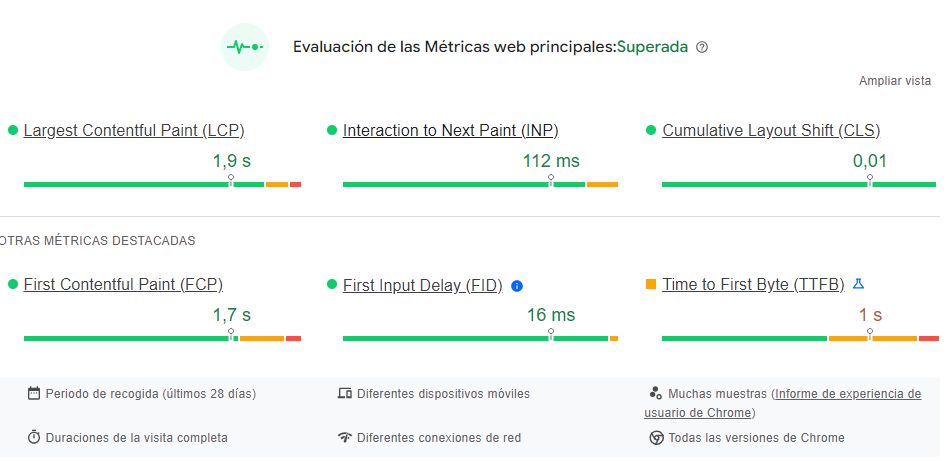
- Javascript web-vitals library (will send information to Google Analytics for later analysis)
- Google Search Console (within the Core Web Vitals section, it will inform us of pages with poor INP)
How to improve the INP of a website
As mentioned above, it is difficult to identify which elements of a website negatively affect the calculation of INP, as we cannot easily run detailed tests on it. The web-vitals library would be the closest thing to that. This complicates the first step to improve INP: identifying which interactions are slow on our website.
As an alternative, we recommend performing interaction tests from your own browser. Click on all navigation elements, menus or dropdowns, interact with videos and other visual components, submit forms, use the internal search... You can note those cases where the website took longer than usual to respond.
The usual suspects that worsen the INP metric are often related to excessive use of Javascript to respond to user interactions. These may include cases like:
- Asynchronous data requests (AJAX) to the server
- Excessive animations
- Iframes and other external elements
- Tracking with web analytics tools
Remember that often the solution to improve INP is not just speeding up the process requested by the user through an interaction. In many cases, adding a visual response indicator will allow you to reduce the INP value.
INP is just one of the thousands of factors and elements that affect SEO. If you need help with optimizing this indicator or with your website's positioning strategy, don't hesitate to contact us.
About the author
Bruno Díaz — Marketing Manager
Professional with a long career as a communication and digital marketing consultant, specializing in SEO, SEM and web projects. As Marketing Manager of the agency, I coordinate a great team of digital marketing technicians of which I am very proud.
Related news


Hello! drop us a line