
Bruno Díaz


Backlink auditing is an essential process in any SEO audit. It focuses on analyzing and evaluating the links pointing to a website, identifying improvement opportunities and potential risks. In this article, we explain how to conduct a backlink audit and what aspects you should consider to maintain a healthy link profile.
A backlink audit is the thorough analysis of all the links pointing to your website. Its goal is to identify:
Conducting audits periodically allows you to adjust your SEO strategy and improve your website's performance in search engines.
When analyzing your backlink profile, consider the following aspects:
Toxic links can negatively affect your SEO. These are links that come from:
To identify them, use tools like Google Search Console, Ahrefs, or Semrush. Once detected, you can request their removal or use the Google Disavow tool to disavow the harmful ones.
The key to a healthy backlink profile is naturalness. This translates into:
Link acquisition is a subsequent phase to backlink auditing but relies on it. This is what we call linkbuilding.
For conducting a backlink audit, these tools can be highly useful:
In this section, we conducted a case study using DRIM toy stores and performed the audit using Semrush. We have no prior relationship or information on this project. Let’s begin:

At first glance, we observe the following:

Regarding the evolution:

Now, let’s analyze the categories of the referring domains. The thematic relationship is crucial in any link acquisition strategy. This chart is essential to identify if most of the links come from sites that are close or far from your niche. In DRIM’s case, we’d expect links from toy-related websites, like manufacturers, distributors, and blogs.
DRIM’s categories are highly diversified, with notable ones being: Retail, Information Technology, Online Services, Media, and Advertising & Marketing. Retail is normal for large e-commerce, as they work with traffic acquisition through comparison sites, referrals, etc., but this distribution is extremely high and could be considered unnatural by Google. The more thematic links from toy-related sites, the better!

Technological websites are unusual and often indicate low-quality links.

The “Online Services” category is typical for large e-commerce, especially if there’s a network of physical stores, as seen here.

Media links are useful for authority but might be too general. They shouldn’t be the only links you have.

Finally, “Marketing & Advertising” links are expected when using tools or collaborating in the marketing field. They’re a good accelerator.

In conclusion: A large volume of links, but the majority are not thematically relevant.

Most of DRIM’s anchor texts are brand-related. There is no clear strategy to highlight categories or specific products.

As for authority, most of the referring domains have very low authority. With 1,000 incoming domains, this is concerning.
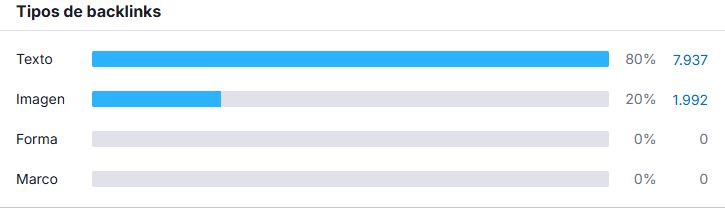
We want text links to dominate. However, there are many image links, which are inevitable in popular sites, especially e-commerce.

Link attributes are also worth reviewing. A natural link profile should have a mix of dofollow and nofollow links, which is the case here.

We’re also interested in the distribution of TLDs. Ideally, we want as many general domains as possible (.com, .net) and if we have a regional extension like .es, the more .es domains, the better. .gov and .edu links are highly sought after.

Next, let’s analyze the similar link profiles. What domains share the most links with us? Ideally, they should be from our same industry. If not, that might raise suspicions.

Regarding the distribution of link profile, we should have almost as many domains as IPs. Low ratios could mean Google suspects we're relying on private blog networks (PBNs).

Next, we’ll determine which URLs those links point to. Usually, the home page gets the most links, but the rest should align with our SEO priorities. In DRIM’s case, 60% of the links go to the home page, which is reasonable.

As for the countries of those IPs: the proximity of servers is no longer important, but some regions like Singapore stand out.

And bingo! All of these links are from low-quality sites. When you spot patterns like this, it’s a red flag.
Conducting a backlink audit is essential for ensuring the health of your SEO strategy. A balanced and natural link profile will help improve your visibility on Google and strengthen your website’s rankings. If you need help with a backlink audit or want to optimize your linkbuilding strategy, feel free to contact us.
After a theoretical explanation, we’ve performed a practical case with a real client. We’ve identified an anarchic and neglected link profile. It’s so careless that it might seem natural, but the key is to have a robust profile with built and controlled naturalness. DRIM should clean up links (remove/disavow low-quality links) and focus on acquiring links from high-quality and relevant sites to become a reference in SEO authority for any toy-related query. They should also focus their linkbuilding efforts on the URLs and keywords they want to prioritize for business.

Hello! drop us a line


A backlink audit is essential for maintaining a healthy link profile and strengthening your website’s visibility on Google.