


05 / 12 / 2023
Search intent (user intent) in SEO

Bruno Díaz
—Marketing Manager
SectorLet's talk about
I admit it: I sold out. I used an anglicism in the title, and it’s completely unnecessary because there is a perfectly valid term in Spanish that defines it accurately: search intent. But the truth is that in recent years the term search intent has become so popular in the industry that I didn’t want to force the title too much.
Content summary:
What is Search Intent?
This concept refers to the process search engines use to interpret our queries—not only to understand the meaning of the words we type, but to understand what kind of information we are looking for and show results with the content and formats that best satisfy our needs.
As we discussed in the post about semantic SEO, Google began developing this approach years ago with Hummingbird and the Knowledge Graph, and has been improving it ever since. Although it still has room for improvement—sometimes it misinterprets our intentions or has serious doubts (hence mixed SERPs). It’s also true that the clearer the query, the easier it is for Google to understand what we want to achieve.
Types of search intent
This is already well explained in our post about types of keywords, but here’s a summary because it’s important to keep it in mind:
- Informational: I’m looking for information about a topic. These queries can be satisfied directly on the SERP or land on a blog page.
- Transactional: I intend to make a purchase and I’m researching for that reason. These searches should land on service pages, product category pages, brand pages, or product detail pages.
- Navigational: searches related to specific entities (brands, people, etc.). If we are the entity, we can capture the traffic with almost any content; if not, we typically need strong informational content.
In Google’s guidelines, they go even further and refer to:
- Know: I want to study a topic in depth. Create high-quality content.
- Know-simple: I want a simple, direct answer. Weather queries, dates, ages, etc. Nowadays 99% are resolved with featured results and deliver 0 clicks to websites.
- Do: I want to perform an action, usually purchase or hire something.
- Website: I intend to navigate within a website. These are usually “site + keyword” queries. The classic “product + amazon”.
- Visit in person: I intend to physically visit a location or local business. Our best weapon here is optimizing our visibility in the local pack.
Recommendations and points to keep in mind:
- Group keywords by search intent: when we target a topic and collect its set of keywords, it’s important to identify their search intent and group them so we don’t mix things up and we save time. For example: in an e-commerce, work informational searches from the blog, and transactional ones from category or product pages. If you’re unsure about a keyword’s search intent, check the type of results on the SERP Google shows.
- Search intent is dynamic: the meaning of a query can change over time—sometimes permanently, sometimes temporarily (e.g., if a topic becomes newsworthy and a news carousel appears first).
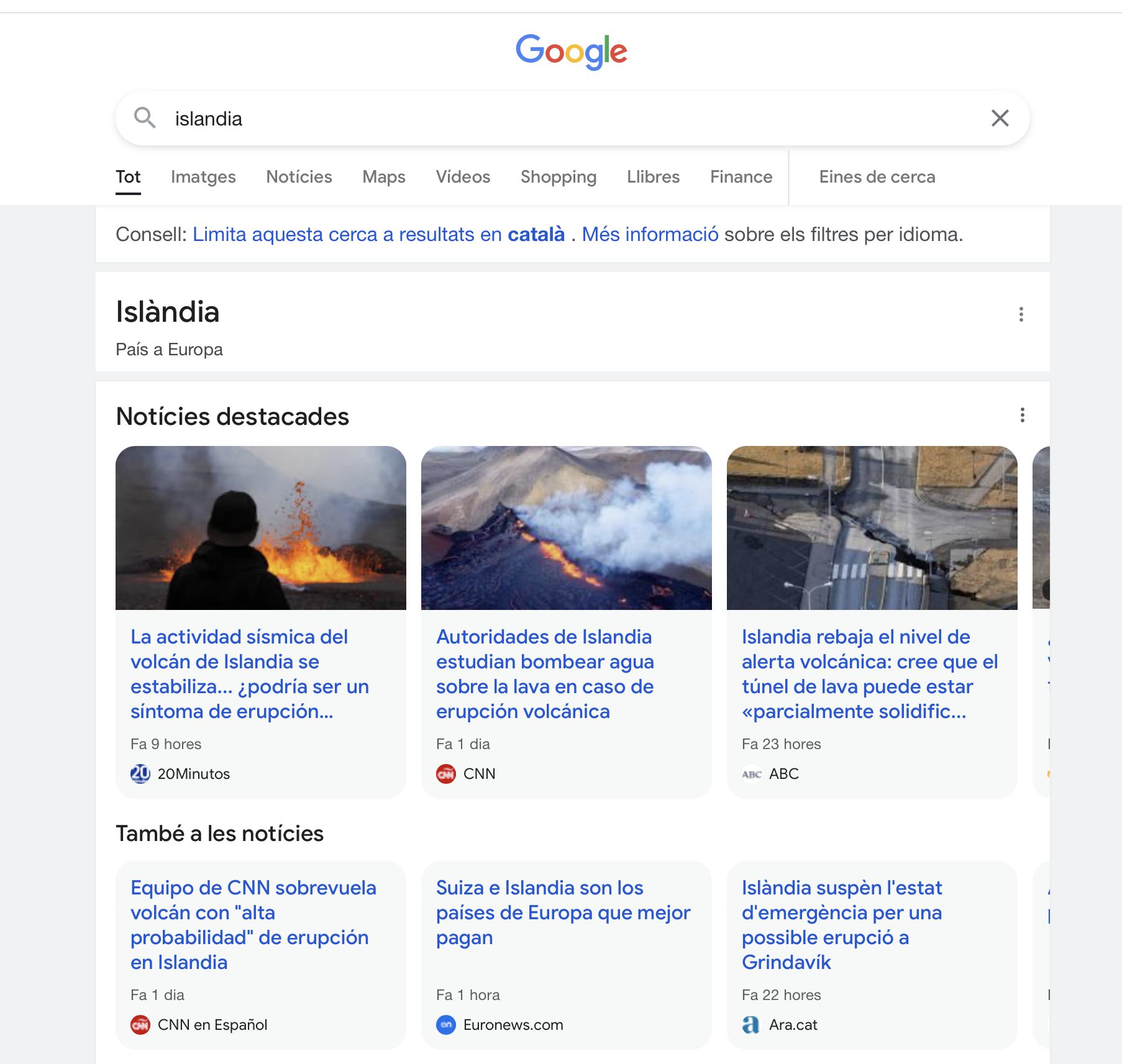
At the moment of writing this post, the query “islandia” shows news about a volcanic eruption. Informational content about Iceland likely has a much lower CTR right now, and results will probably shift again over time—returning to previous types or changing entirely. - Don’t invest time trying to rank for know-simple intent queries: it seems obvious, but thousands of websites that previously got traffic from these searches have lost it—and it won’t return.
Conclusions
Today, any serious keyword research cannot rely only on traditional metrics like volume and difficulty. Keywords must be aligned with the search intent behind them and with the types of Google results we will be competing against. Only then will we be able to assign each keyword to the content format with the highest chance of ranking.
About the author
Bruno Díaz — Marketing Manager
Professional with a long career as a communication and digital marketing consultant, specializing in SEO, SEM and web projects. As Marketing Manager of the agency, I coordinate a great team of digital marketing technicians of which I am very proud.
Related news

Hello! drop us a line