
Bruno Díaz


On many occasions we are contacted by companies to appear in Google and AI searches, and especially for ChatGPT. And in these scenarios, we usually propose a package of actions to optimize aspects of the website that will help us maximize its presence in the responses of attendees and search engines. On many occasions it means rethinking many things about the website: design, usability, content, web architecture, etc. Sometimes this is feasible, but we will often encounter a lot of resistance: time, resources, budget, or acceptance by the actors involved.
But on other occasions we have a blank canvas in front of us: the possibility of proposing a web page of 0. Here we are going to have much more margin of incidence. Here we can plan websites from 0 so that they can be positioned in artificial intelligence (GEO) and search engines (SEO).
To achieve this, the essential thing is to introduce positioning specialists and their vision in all phases of the web project. Beauty in design is important and programming functionalities are facilitating, but we must be clear about the center and objective of that web project: to attract business for my company. The web project must move all the actors like a synchronized orchestra, each one playing their score but all oriented to a common goal.
So marketers and especially SEOs should be involved in all phases of project development. Here we will see aspects of each of them from this perspective:
In this phase we must identify what services/products we offer, and to whom we want to sell them. And of these, which are the most important. With SEO tools like Semrush, Ahrefs, and more, we can identify search volumes and patterns. Keyword research should be the basis of the web architecture, design and content to be proposed.
Although in my opinion, before opening the keyword study, I like to start with something more basic: define and clarify our value proposition.
If the answer to these questions is not clear and positive, leave it here, because it will not go well. Even if you make a wonderful website and SEO from another galaxy, you won't have a run. But if it is positive, there is water. So to the pool.
So we started a study that is not an Excel with keywords and volumes, which is also important. It's a pre-project SEO research:
The structure and contents of the resulting website must respond to this. It will help us here as well to research what the competition is working on and positioning. From here, yes: we need to get keywords, with their search volumes, and other important aspects like their search intent, or what elements we'll see in the SERP results. Detect if there are images, maps, videos or AI summaries in the results, as you will have to attack differently to appear. By the way, at this point: what to do with searches that trigger AI overviews? Well, there are many manuals here: there are those who avoid them (they won't bring me clicks), and there are those who separate them to work on them in a different way, but seeking to appear in them. But a priori having control over which wants activate them and which don't, I'm going to be interested. You can complement classic keyword tools with more modern AI tools upstream and downstream: Claude, Gemini's Deep research, or NotebookLM can help you, well-targeted. But don't let so much modernity make us forget the classics: research on networks, forums, reviews or youtube, can be very valuable to extract the most common doubts and problems of users. And the combo would be to extract all that content from the investigation, pass it through the AI so that it infers the common traits.
Throughout this process, it is important to focus on the recipient: the website is not for us, it is for the users. We are solving user needs, and our message is for them. You must understand it and put the user at the center. Who is he? What language do you use? What pain does it have and how do we solve it? Think about what type of web design, navigation, messaging, and solutions will suit them best. If you work with clients because you are an agency or freelance professional who proposes the project for a client, beware of one danger: ending up building the project that our client, the company that pays us, wants. And it can be a failure: the project is not for our client but for our client's prospective client, and that often leads to problems in the process. But it is better to face them from the beginning, because we are interested in the website having results and having a long-term relationship with our clients, as luckily often happens in our agency. And this happens because they earn money thanks to our work. Period.
It does not affect our field here but other aspects that will affect the viability of the project must be investigated: economic resources, logistics, monetization and payments, and legal aspects. Without all this tied up tightly, we may be building a house of cards.
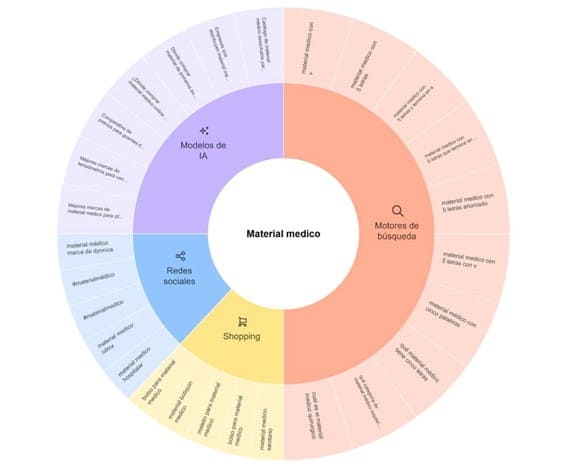
With the keyword study carried out and validated with the client, we must obtain a list of URLs that we will need to create for the project, grouping keywords with the same search intent in each of them.
Depending on the intention they cover, we tag these pages by the type of page they answer: home, listings, product/service sheet, corporate pages with EEAT (who we are, legal, conditions, team).
Once we have the list of pages, according to the keyword study but above all with the client's business priorities, we identify the pages by degree of importance. To taste, but generally 3 levels will be enough.
On the other hand, we must group the pages by theme. This will allow us to create clustering of thematic content: everything related to a topic on our website, regardless of the type of page, must be intertwined. In case it's not clear, let's give an example: if I have an online store for household things, everything related to drills (product pages, product categories, brands that sell drills, blog posts or experts on the subject) should be intertwined.
Well, when we have all the pages defined, their typology, theme and importance, we must define how we get to them from anywhere on the website: define a web architecture.
It is clear that the resulting page you will want to be as optimized as possible at the level of On-Page SEO: hierarchy of headings, content density, meta tags, etc.
Well, the interesting thing is that as SEOs we imagine what we want the On Page SEO structure to be like, and we define it for each type of page before it goes to design. This way, the web designer will propose the most beautiful and attractive website possible.
Using wireframing tools, propose a base structure for each page. For example, for a product sheet you could ask
If it is not the first post of ours that you read, you will keep in mind here that SEO is important but it is not the only thing. We need them to come to our URL, but the most important thing is that they buy from us. So go a little beyond the boundaries of SEO. We will see some examples of this in the next section.
Thanks to the previous sections, we must be clear about the priority services or products in our web project. Now we must evolve it to find what kind of messages, catchphrases, offers and urgencies are going to unlock the user's doubts so that they reach where we want. We must define what messages will lead the user to buy our speech, and consequently our product or service. Depending on the sector, users and other aspects, this will change. But always keeping in mind that on most websites our objective is not to inform, it is to sell. Get a tattoo and you might tell me "I'm SEO, or I'm a web designer". Very good and congratulations: but if this website doesn't sell, we're all out.
Think of a common product or service sheet: we provide information about what it is, its characteristics, the conditions of purchase, its user manual, etc. And that's all very well. But that forgets that the focus should always be on what pain or need our potential user has, and how our product or service solves it. Imagine a different tile structure:
And from here, put value on what you are selling, to raise the perception of the quality of what we offer, and leave the price in the background (even if you do not present it). There are many resources in the basics of marketing, and for each project you will know how to see the ones that fit the most:
There is no need to deceive or lie. That is bread for today and hunger for tomorrow. Simply value the product/service and what it solves, defend it and present it in the best way.
The contents of a website, both in copy and multimedia, are very important because without good work behind it, the best web design, strategy and programming end up being useless. Here my advice is that the core of the content comes from the people inside the company: those who know our brand, products, services and customers inside out. Logically with the accompaniment of our marketing specialists, and being consistent with the SEO strategy.
What content to prioritize? Well, in point two we have already done the exercise of identifying which are the most important pages. So we should put our utmost effort into it. In short: the pages that we expect will give us more money (usually a selection of products or services), plus the pages that will give us the necessary packaging to be bought (home, who we are, quality, etc.). The rest is important but not so important, and will depend on the resources available. If we have a large site and we don't have the resources to work on the content of most of them, I prefer 5 perfect pages and the rest badly, than all of them regulated. Prioritizing and perfecting the priority is often the best way.
From here, the data and circumstances will lead you to decision-making: enhance a type of content that works, prioritize a vertical that we are interested in pushing, etc.
It is a recurring question from our customers. Historically my answer was always YES, because of its benefits in terms of traffic and SEO. Now my answer is DEPENDS. The first thing we must ensure is that all the key content of our transactional or trusted website is perfect: services, product, corporate pages. Once this is resolved, we will be able to dedicate resources to the blog. While it is true that Google's traffic for information searches has plummeted since the emergence of AI, it is still interesting to work on the blog. But to do it from a different perspective:
If what you are worried about is GEO, you should continue writing on the blog and do it to please those wonderful robots: structure the content, put FAQs, infographics, comparative tables, take care of the EEAT of that content. Because where do you think he gets the information for his answers? Being among the sources of AI consultation brings you closer to being among the answers.

Hello! drop us a line

If your website isn’t designed to attract business from the very first click, it’s not an investment: it’s an expense.