


16 / 03 / 2026
Step-by-Step Guide to Ahrefs

Bruno Díaz
—Marketing Manager
SectorLet's talk about
Ahrefs is a tool that was born as a specific tool for link building. And although today it is still the best tool for these purposes, we are now facing a very powerful all-in-one SEO tool, if not the most. In this post you will have a review of the tool to see its main uses, and the best tips to take advantage of it.
Quick inquiry
Analyzing websites without creating a project: Site Explorer
If we want to analyze a website in a specific way, for example if we want to analyze a competitor or a possible customer, we use Site Explorer. We enter the domain and that's it:
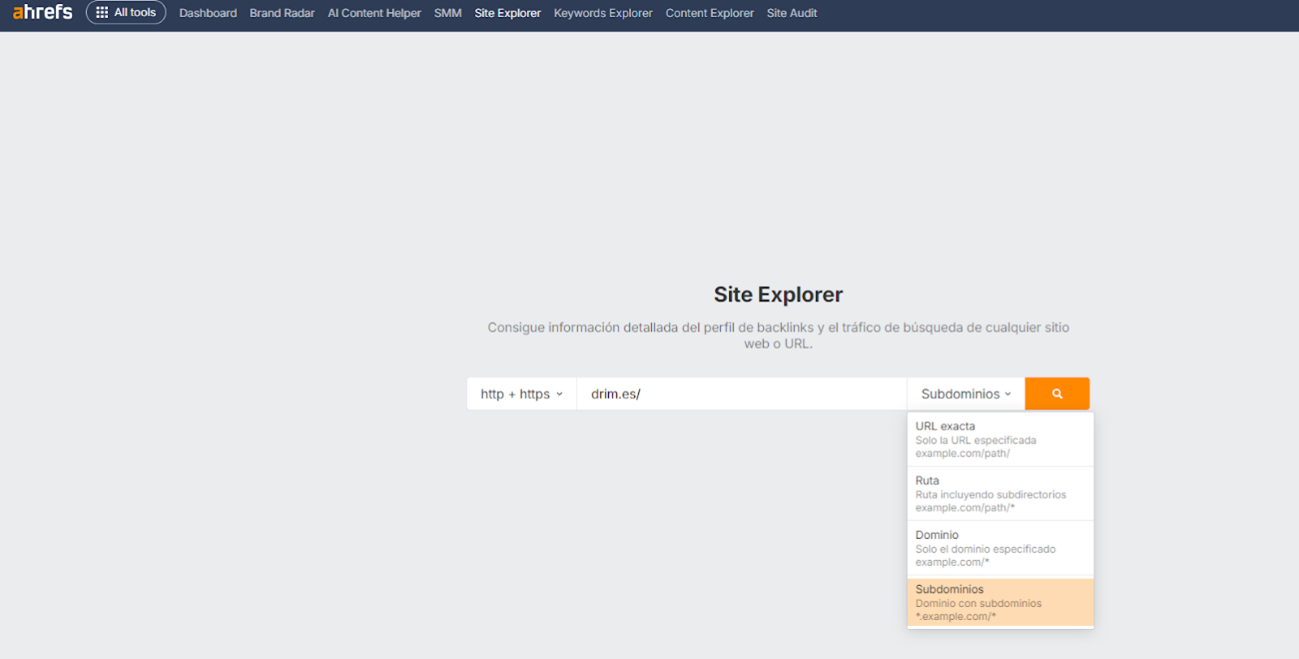
As you can see, we can analyze the entire domain, or a specific URL, a folder or a subdomain, depending on what interests us. We'll look something like this: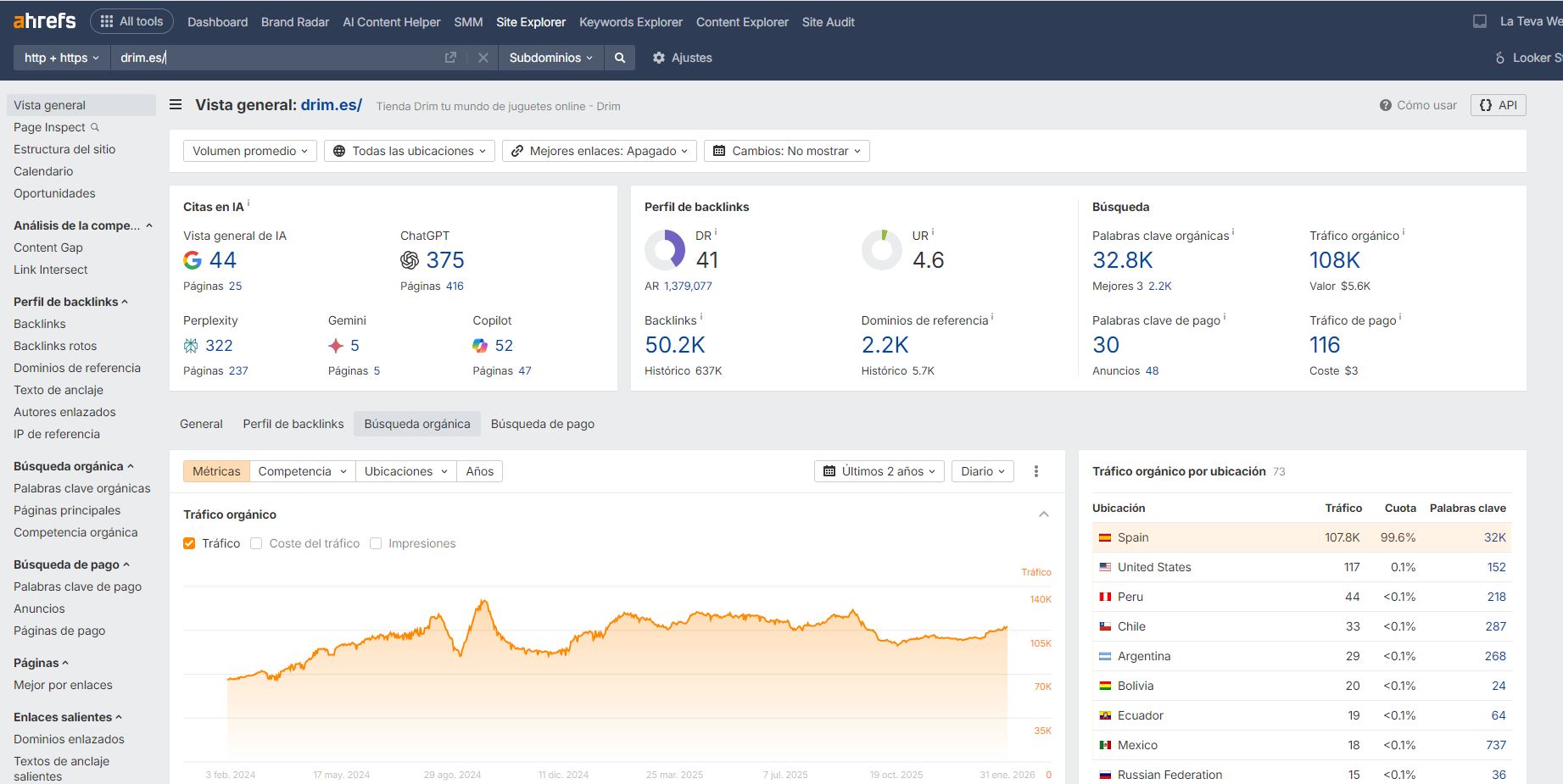
Here we will see very relevant data of the domain to be analyzed. The first blocks we'll look at will be your AI visibility, your backlink profile, visibility in Google Search and Paid, organic search evolution, and traffic by country. This already gives us an idea of where the shots are going, but in this view there are much further down and dozens of specific utilities to your left. Let's look at some sections in more detail:
AI Quotes
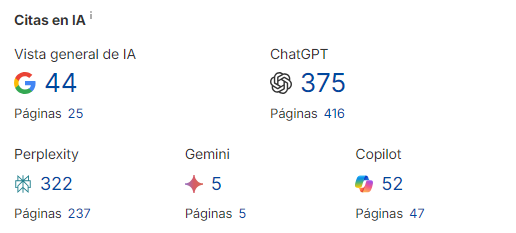
In this section we have an overview of domain visibility in the responses of the main LLMS. It's an appetizer of their specific Brand Radar tool, very cool and very expensive too. In any case, here we already see from the outset which AI we have more visibility in two dimensions: how many times our domain is linked to in the AI results (which are not mentioned), and how many pages of this domain are targeted.
Backlink Profile
In this case the tool gives us an overview of your link building policy. We see a metric of its own called DR, which is a way to give you a rating from 0 to 100 of your link profile. We are analyzing a well-known profile in this case, most common domains do not reach 10. Think that the metric makes a Gauss bell with the Ahrefs database and there you are with very powerful domains and the smallest ones do not even appear. I wouldn't give this metric much importance, but it can be an indicator. And it will be a reference for many of your customers, so you have to go through it. While the DR measures the value of the domain as a whole, the UR measures the value of a specific URL, since sometimes we may be interested in knowing the specific authority of a page, post or product. In backlinks it shows us how many links it has detected from other websites pointing to your domain, and in domains how many domains link to yours from (this is because we can often have more than one link from one domain to another).
From the example we have given you of drim.es, at first glance we can see:
- It has a very remarkable DR, although it doesn't tell us much if we don't compare it with other domains of direct competitors, to know where we are. In any case, a 41 is powerful
- It has an abnormally low UR in correspondence. This may indicate that the link building strategy has been diversified across several URLs
- It has more than 50,000 backlinks pointing to its domain, which is a real nonsense. But the really striking thing here is that the tool's history was much higher, so some Drim SEO will have detected some inbound links that did it a lot of good and has removed them
- The referring domains are just over 2,000. This is already more reasonable, and reasonable given the customer. If we make a relationship, we will see that on average 22 domain links, a somewhat high figure but normal if we have done affiliate campaigns, banners on other websites or some similar action, because in a classic link building action it is normal to get a single link from each domain. Here you can also see the cleaning they have done.
If we want to delve deeper into the link profile, we have these subsections:
Backlinks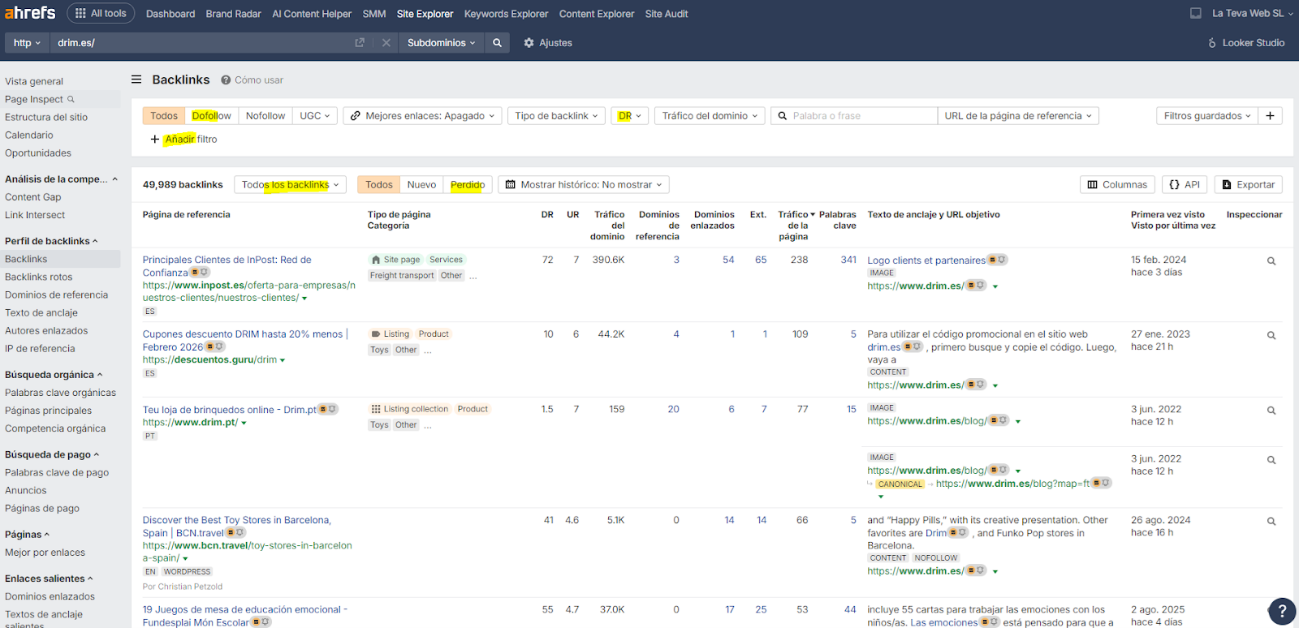
Here we see the detail of all the links that point to our domain. The information is overwhelming for mature projects, so play according to interests: you have numerous filters and sorting methods. Here we may be interested in:
- Getting only the Dofollow links, although it's not as important as it used to be, now that we're in the hype of SEO for AI
- Group links so that you only show me one per domain
- Filter by DR rating, to get the best or worst links (the latter can give us clues of domains to unlink or if we can't, disavow with Disavow)
- See lost links: A link we had may have been removed and you're interested in chasing someone back to get it back
- Comparison over time: we can make comparisons of up to two years to see lost or gained links
There are an infinite number of filters and sorting ways that we can use to get a group of interesting backlinks: by keyword, by domain, by domain traffic, links marked as UGC or sponsored, and a long etcetera. And at the top right you can customize the columns that we see and export the data in your favorite format to work it out.
Broken Backlinks
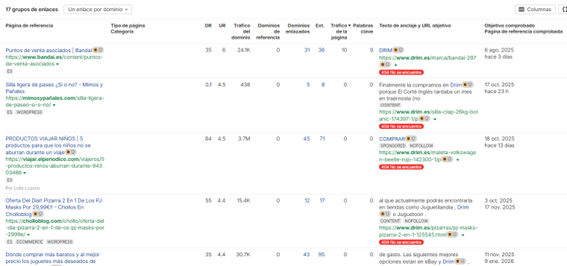
This is very interesting and gives us clues to something that is important and that depends on us. Here it shows us links that we have from other websites to URLs of our site, but that we have broken. Here we will usually (but not always) find links from our website that have been removed. If the inbound link is relevant, consider restoring the lost URL or redirecting it to a similar page. Keep in mind that if you don't have an equivalent page and you direct it to the homepage, the thematic force of that link can be lost. Although it will always be better than a 404.
Referring domains
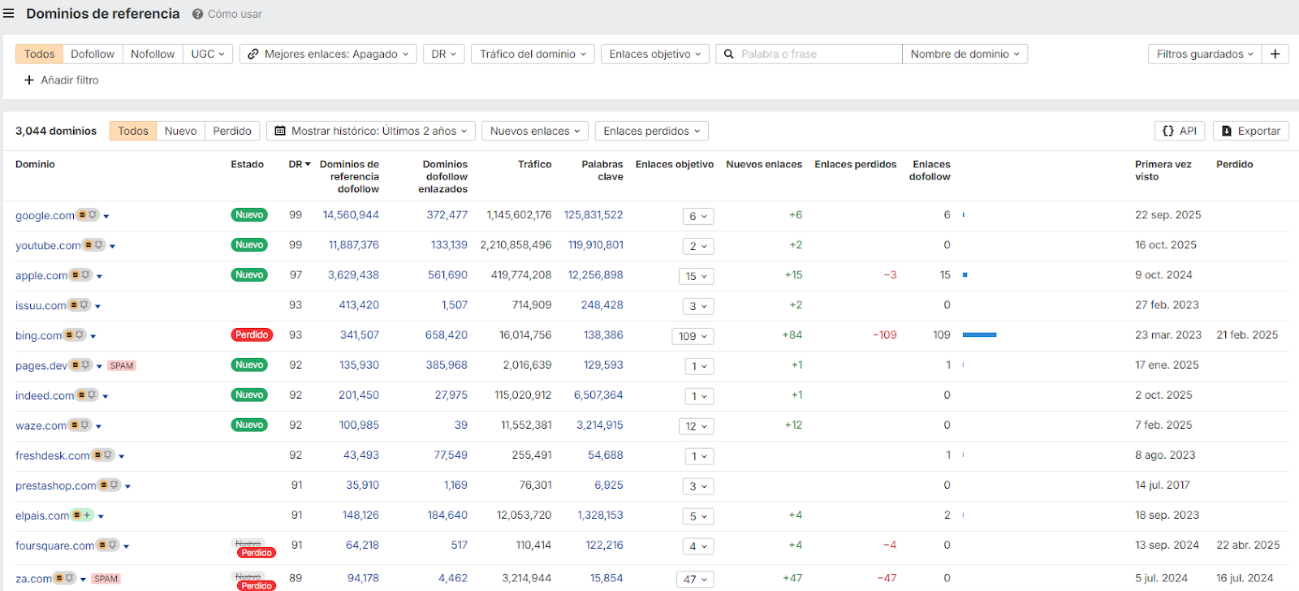
In this table we will see the detail of the domains that point to our website. We see a lot of details like if they're new or lost, their DR, and so on. Perhaps the most interesting thing about this view is to see if we have lost any high DR links, or sort by target links: here we can detect domains that include many links to us, which we may be interested in moderating. For example: that old practice of putting a link in the footer on all the pages of a site, well, it's a bit risky, if you detect it, attack it.
Anchor text
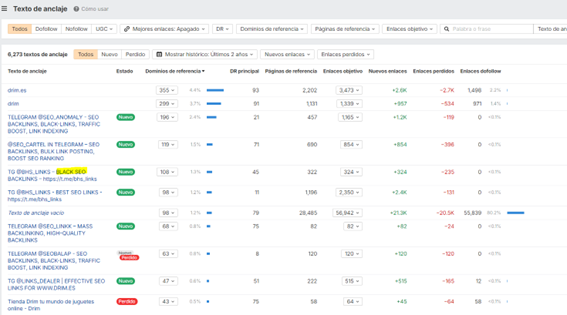
What we are going to see in this table is what visible text there is in the link that points to our website. In general, it can be interesting to see if the concepts have thematic relevance or not. An interesting filter I often apply is to see links with empty anchor text, which is usually for links from images or banners. It is interesting that whenever we can, the link includes a text that has relevance and thematic relationship, although it cannot always be. But sometimes we get surprises, as in the example we see: it has helped us to detect links from websites that want to hurt us, they are negative SEO.
Referral IP
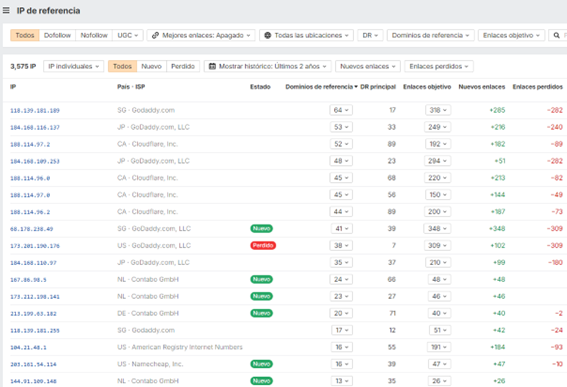
This section is becoming uninteresting over time. In any of the cases here what we see is on which IPs those pages that link to us are hosted. We see your IP address, country, hosting provider, referring domains, and so on. What can be interesting here is to detect if there is an excess of links from the same IP, which could be interpreted as an abuse or a PBN (private blog network), something that does not interest us. Note here: if you have several own or associated projects that link to you, as far as possible, it is better that they are in differentiated IPs.
Another pattern detectable through this tool could be to detect that we have many links from countries far from our positioning goal (Russia, China, etc.). This type of analysis is becoming more and more tedious since most websites use large providers or even CDNs such as Cloudflare, and this detracts from both the geolocation of the IP and its diversity. In any case, a priori what we will be most interested in is that there is a high number of links from machines hosted in the countries in which we want to position ourselves. Or it could also be a clue to stretch against possible negative SEO attacks if we see many suspicious links from the same IP.
Linked Authors
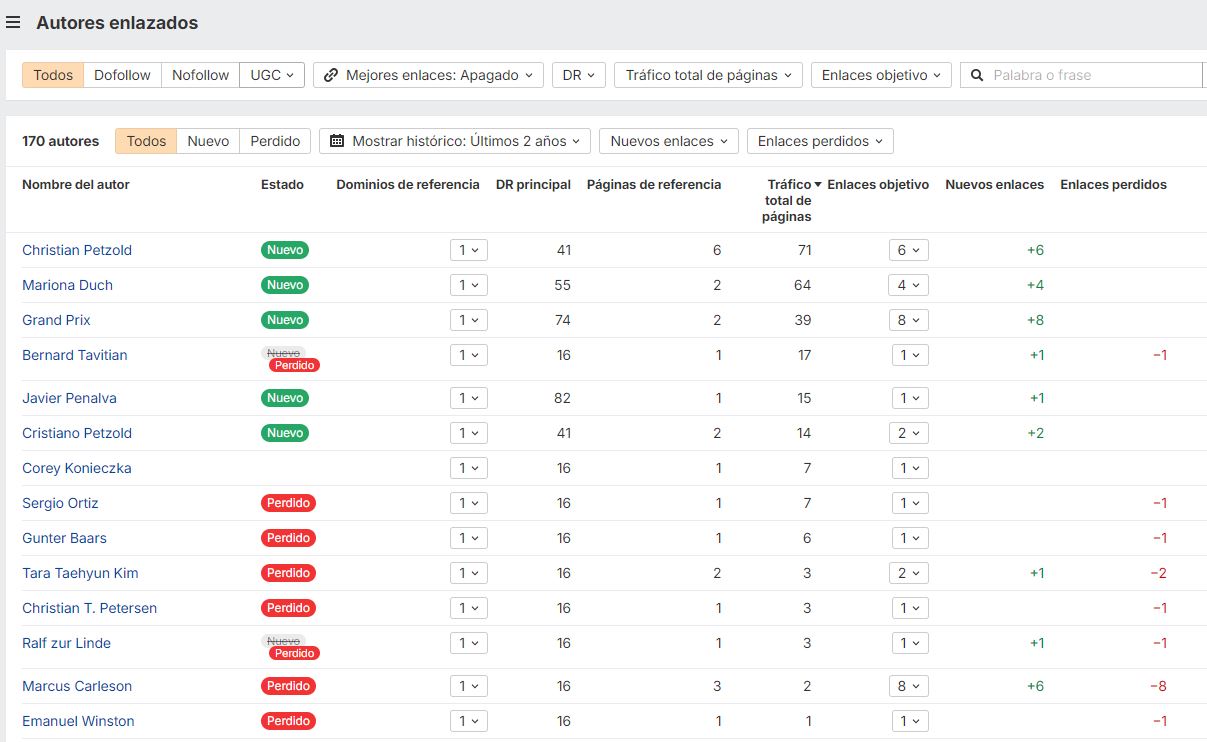
In the era of EEAT , authorship is a relevant factor in determining the quality and relevance of the content that bots are going to process, which is why we have this tool available. What it tells us is the authorship assigned to most of the links that enter us, who signs it. What might interest us here? That they are relevant personalities in our sector, and that there is the greatest possible variety.
Outbound links
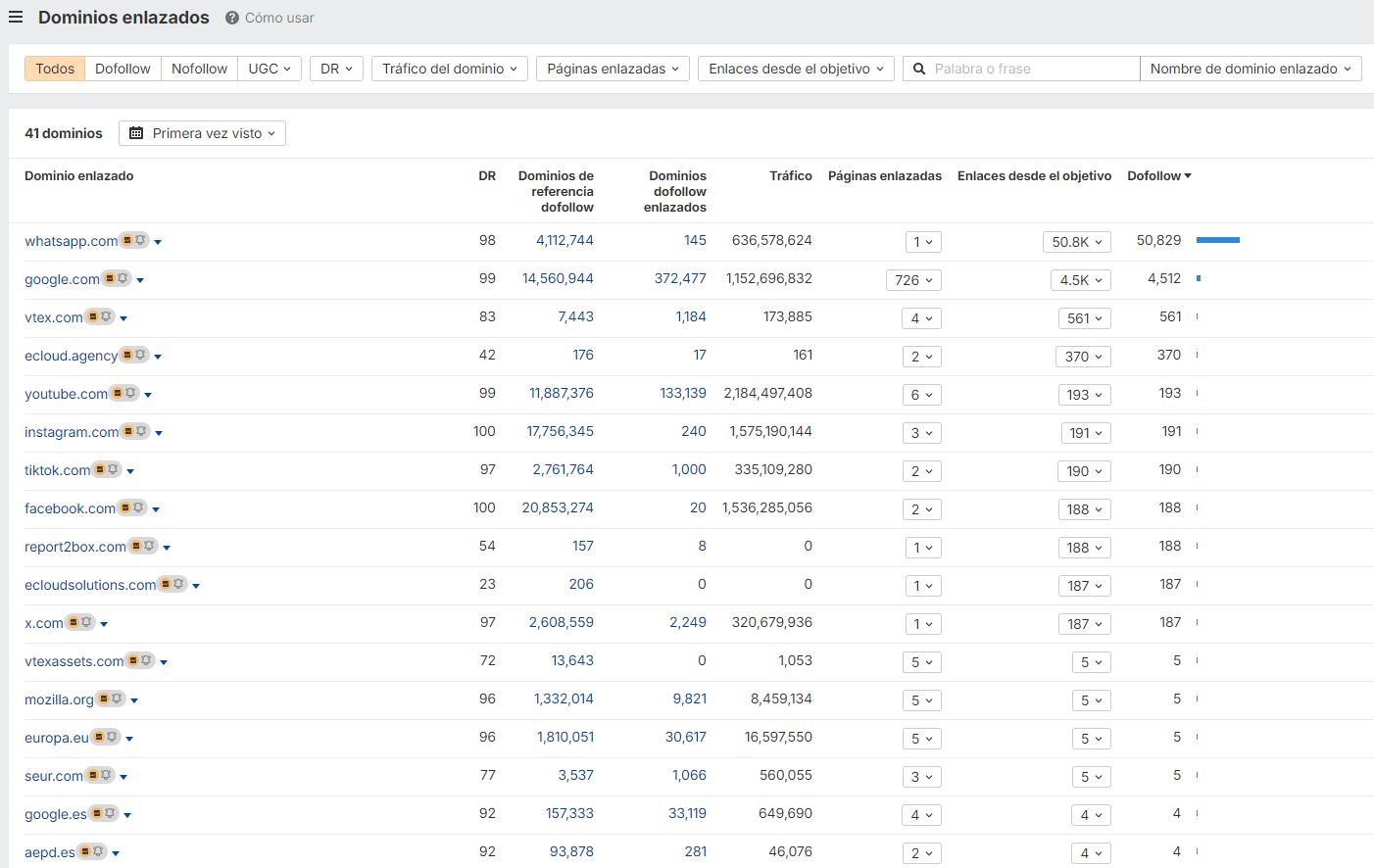
A good backlink audit should take a deep look at inbound links, but also outbound links. In this view we're going to see which domains we're linking from ours. There each master has his booklet. In the past, it was advisable to minimize outgoing links as much as possible, as we are granting authority to those who may not interest us. But nowadays the game has changed: if we want to make quality content with depth, the logical thing is that we take information and mention other websites. In this context, I think that mentioning and linking to them is something natural, that Google will value positively and that it makes common sense, especially if they are relevant websites in your sector. So I would be selective but generous in this. I don't identify all the outgoing links in this example project, but I do identify most of them: they are social networks, suppliers, manufacturers that Drim distributes or official bodies. It seems reasonable. Although an interesting exercise could be the opposite: sort outbound links by upstream DR: maybe there you will detect domains that you should not have linked, or that one day you did and today they have been reviled, reprimanded with a red card or removed.
Outbound anchor texts
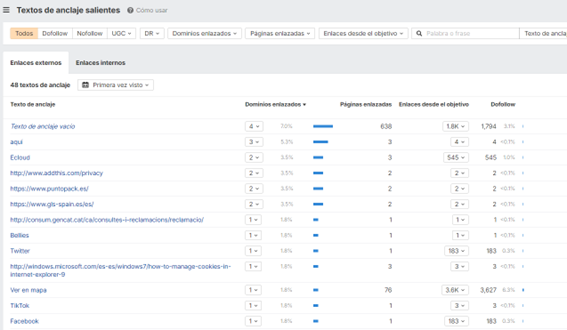
In the same way that we must analyze the anchor texts of inbound links, we can do the same with outbound ones. As you will understand, the interesting thing here is to detect links without anchor text, with non-descriptive texts or we could even detect suspicious patterns: in an SEO audit of a media with this tool we detect a lot of outgoing links with anchor texts with poker, casino and others. They had been hacked and hadn't detected it... until then.
Organic Search
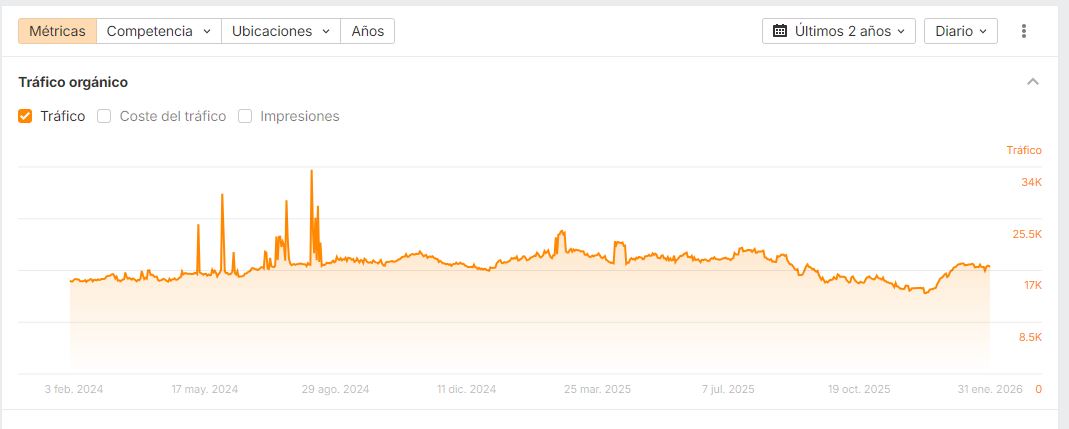
Here we see an estimate of the domain's organic traffic, and its evolution over the last two years (this is what will come to you by default, it can be changed). A somewhat distant estimate, if you have access to the analytical data of the project, you will see that it is far away, but it detects sudden changes and major trends. Think that what it does is see what keywords the domain is positioned for, what search volume you have, and by the position it infers a probability of clicking, and from there it obtains a figure. With this graph you can play around and incorporate other data such as competitors, locations, estimated traffic cost or play with dates.
If we want to delve into this, let's go to the Ahrefs panel that we will see on the left of the same name:
We click on the first link, and that's the basis of Ahrefs: our universe of ranking keywords!
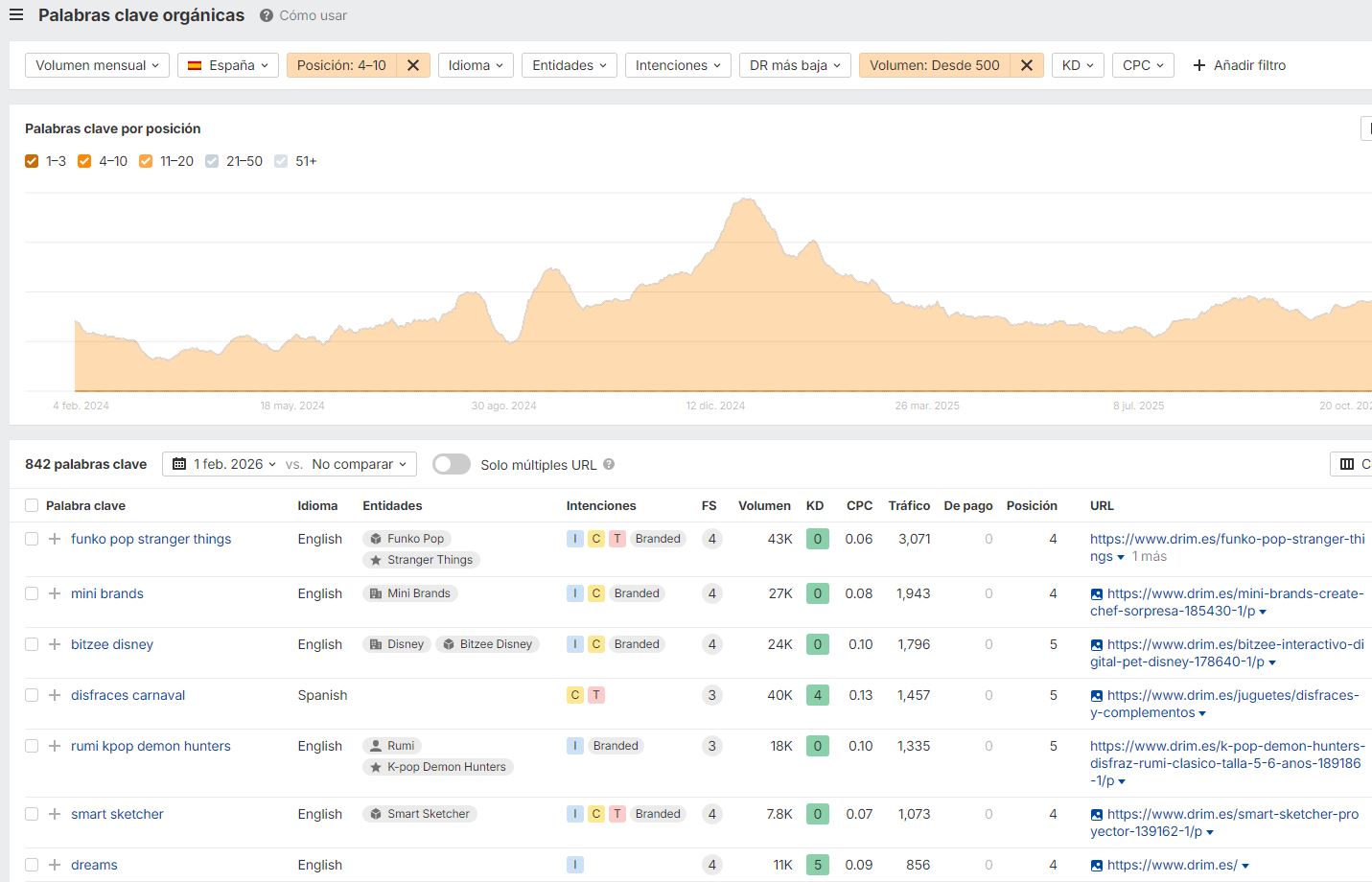
If there are many, filter to your liking. One thing I really like to do when we start working on an SEO project, is filter by opportunities. The client is going to want results in the short term, so try this: we filter by the country we are interested in, keywords that are in positions between 4 and 10, and that have a worthwhile search volume. The result is TACHAAAAN, the words you should focus on. It even tells you the URL you're ranking for, the search intent, and the entities mentioned. Filter with the client so that it makes business sense, and go for them: check their On-Page SEO, usability, incoming internal links, external ones that point to them, etc. This will give you quality traffic in the short term and you will gain the customer's trust in the first few weeks that are key. Now you can more calmly start looking at keywords that you have on the second page or beyond, or those that you don't even "rank". But in SEO, 95% of success consists of a correct prioritization of tasks.
Organic traffic by location
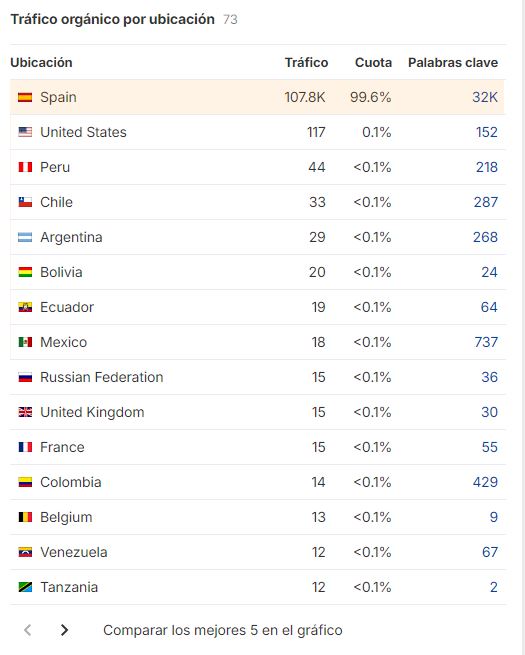
In this chart we get a bird's eye view of the geolocation of our searches. We see the organic traffic by country of origin, and the keywords ranked for each territory.
For the example in question, the numbers are very clear: 99.6% of organic searches come from Spain, and the rest is anecdotal. Given the nature of the business, the data is favourable: we are an e-commerce that sells and ships its products only to Spain. The fact that the website is only in Spanish and that they use a territorial domain, .es, gives signals to Google of our positioning intentions and in this case it has interpreted it correctly.
We have seen other cases in which this is not the case, I give an example:
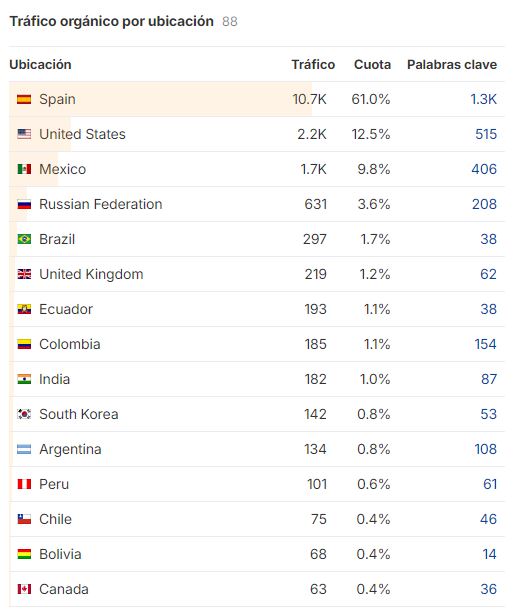
In this case we have only 61% of the traffic from Spain. It could be a website with the intention of international positioning, but this is not the case. If we are faced with such a scenario, we have two paths: try to correct this trend and concentrate traffic in Spain through SEO actions (change of domain, reinforcement of hreflang signals or with geolocated link building actions) or take advantage of the opportunity and study if we can monetize that traffic from other countries by offering online services or international sales.
Organic positions
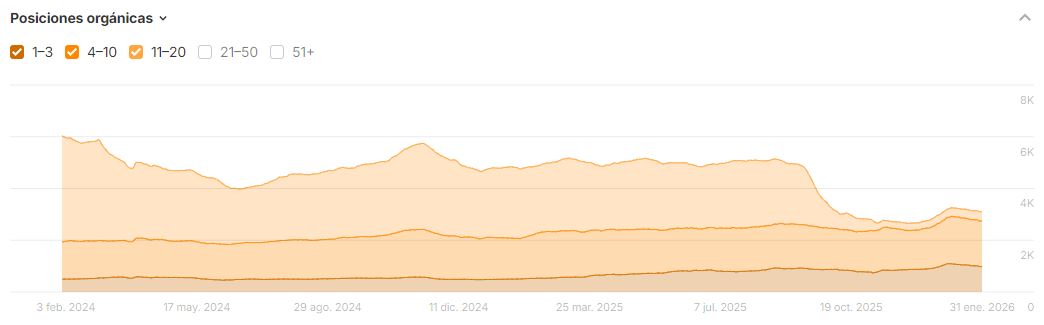
This graph shows us how the domain's keywords rank. It groups them according to whether they are in positions 1-3, 4-10, 11-20, 21-50 and +51. As you well know, most clicks go to the first group. From the example it seems like a stable project but the keywords have dropped in positions 11-20, although it seems more like a change in the way the tool is measured, due to some work that Google put on tracking tools in 2025.
Organic pages
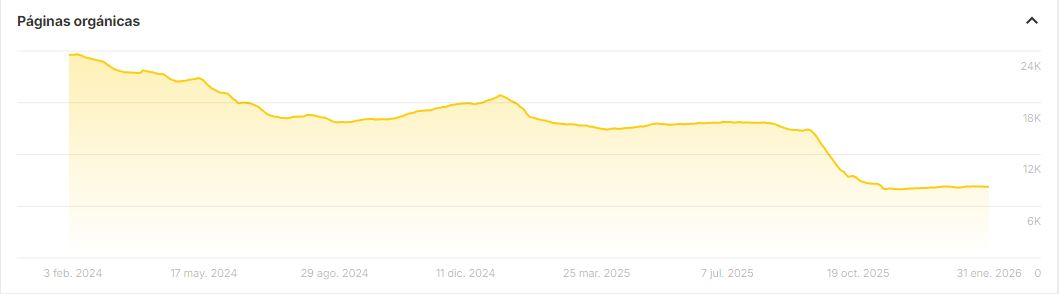
This view allows us to get an idea of how many URLs the domain has indexed. It would be something similar to that site: that you will have done on some occasion. This domain in question detects more than 8,000 URLs, something remarkable but not enough for such a large e-commerce. What's striking about the example is that indexed URLs are now 4 times less than two years ago. What could have happened here? Well, a process of de-indexing , whether desired or not: a partial migration of domains, that a large part of the content has been loaded, or that they have consolidated it by unifying products or canonicalizing. Sometimes less (URLs) is more (traffic).
Main pages
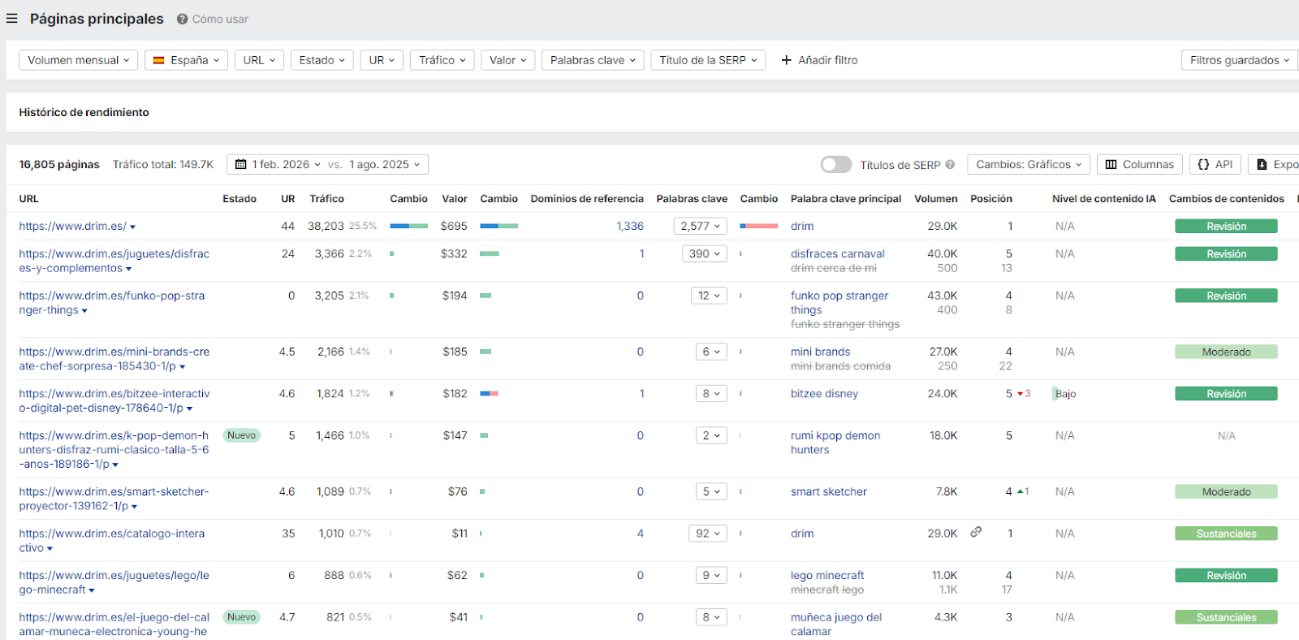
This subsection delves into the above. In it we see the pages of our site with the most SEO value, the ones that are attracting the most traffic. We see the URL, the estimated traffic, if it has changed, if it has referral links, the keywords it assigns, its main keyword, search volume, eye even the level of AI content and if the tool has detected recent changes in the content. It can give us a . I must admit that I use this utility more often for external domains: if we consider a link building action on another website, it is not enough to see its DR. You have to see which pages bring traffic, because they may propose a link in a URL that you don't even visit and also their traffic may come from keywords far from our objectives. To the parrot with the latter. For our own project, it can be used to detect URLs that are gaining strength and we may be interested in strengthening, or internal URLs with potential but without incoming links.
Best by links
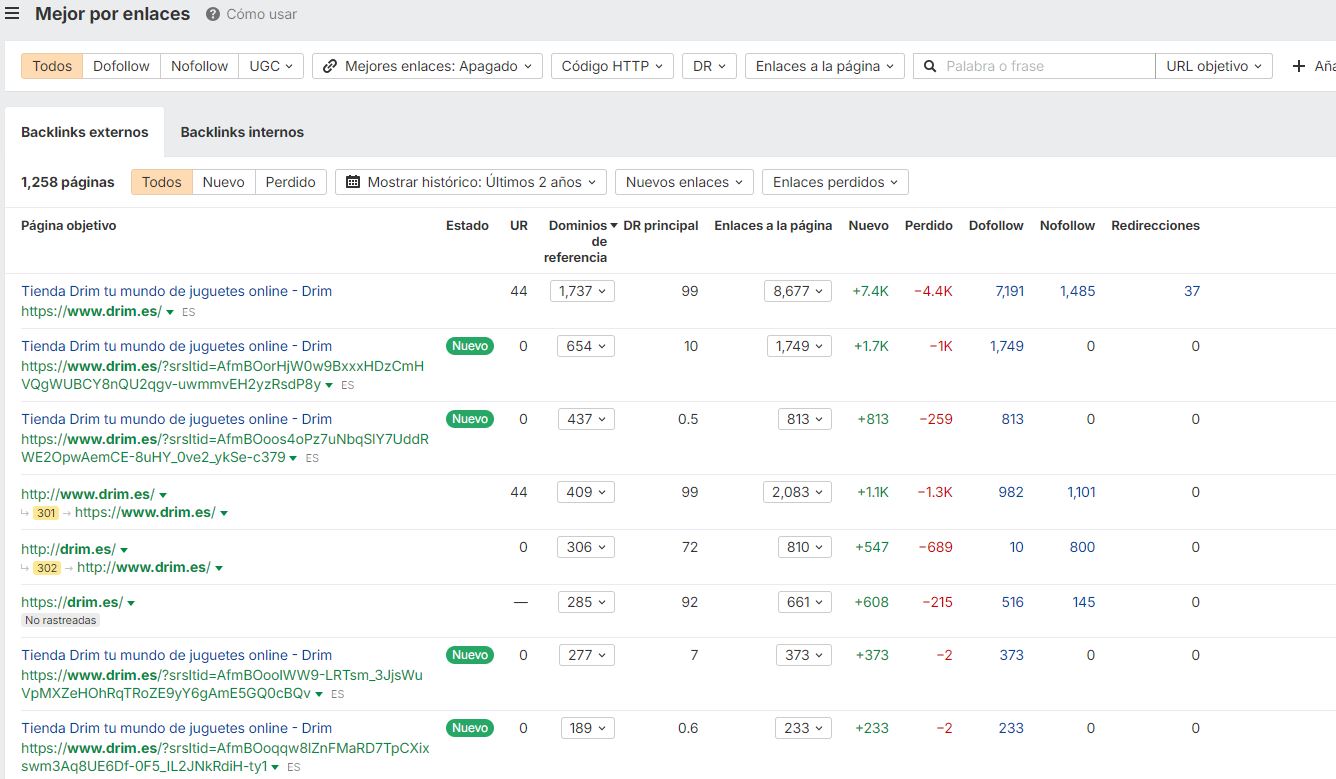
In this subsection we see which URLs of our domain the external links point to. This will give us a view of how evenly distributed that external force is within our domain, and spinning a little more will help you determine if the links on your page that are most linked to are the ones that interest you the most, or something absolutely random or secondary. In that case, get your hands on it, because in the end this should be a reflection of your business priorities.
Organic keywords by intent
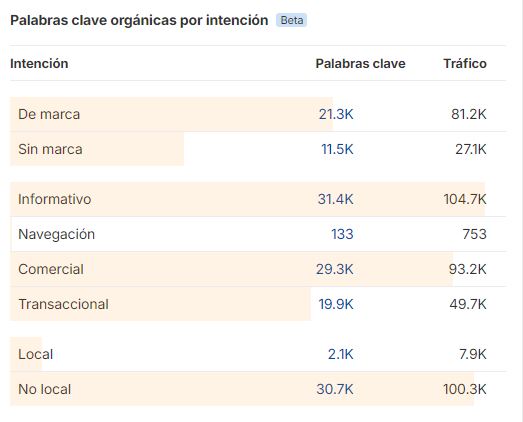
This panel is in beta but it's tremendously interesting. Group our keywords positioned from different perspectives:
- Whether they contain a trademark or not (it can be their own or someone else's)
- Your search intent: informational, navigational, commercial, or transactional
- Whether they have local intent or not
In view of Drim's example, as we have seen in another panel, many searches contain brand. A lot of information search is detected, but also a lot of sales. What's really interesting is that even though Drim has physical stores, they represent a very small share of the overall search to the website. It has a certain logic in a very mature market in e-commerce, and in which many users are looking for very specific products. Here the interesting thing for the client is that from each grouping they go to specific word groupings to delve into them.
SERP Features
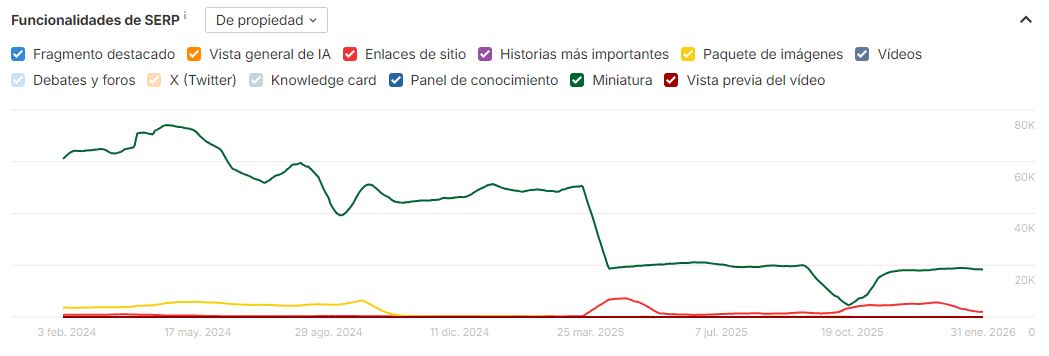
Nowadays the SERPs are more and more plural, there is a little bit of everything and not just the classic 10 blue links, and this is the main headache of most SEOs in recent years (especially SEOs who don't want anything to change, because they have dedicated themselves to something else darling). In any case, what we are interested in here is to understand in which formats the content of our site is displayed in Google results.
In the example we see its visibility is basically in thumbnails (sitelinks with link + image) and sitelinks plainly. It seems that it has hit a significant downturn, and it is striking that it no longer has visibility in the image package, as it is an e-commerce. Or that the image pack is practically no longer displayed, displaced by others. But perhaps what worries me the most today is the lack of visibility in the AI overview.
Featured entities
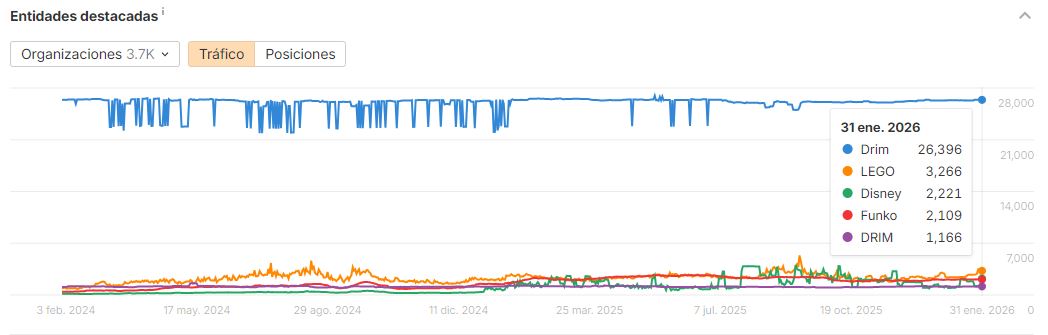
Entities play a decisive role in modern SEO. Google relates keywords to those personalities, places or brands that are searched. We are very interested in knowing which entities are related to the searches we are trying to position: if they are related to our sector, to our business intentions, etc.
From the example we are working on, we can see how the main identity is the brand itself, Drim. This is very good because it indicates that our identity is relevant and of interest to the consumer. But be careful because in this case we are a multi-brand e-commerce, without our own brand, and consequently we will be interested in positioning ourselves for the brands we sell. The tool tells us that its most powerful entities are LEGO, Disney and Funko. They are 3 very powerful brands and very fashionable in these times, so it fits us. But the important thing will be that this fits into the customer's dashboard: these brands must be the ones that interest us the most in terms of stock, sales, margin and so on, otherwise, it must be changed.
Branded organic vs. non-branded traffic
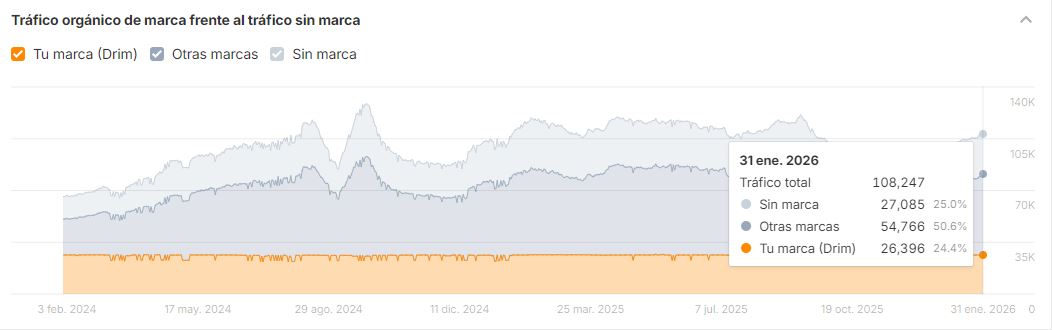
This is already getting more interesting and complex. Here are three types of searches: those that do not include any brand vs. those that include our brand, vs. those that include other brands. This is very relevant to understand how much of a brand our audience is, and how dependent we are on external brands.
From the example we are seeing, the thing is predictable: 50% of the searches that bring us traffic include other brands, 25% do not include any brand, and the remaining quarter include our brand. SEO work par excellence focuses on searches that do not include a brand, as they are the most meritorious (I want a doll, for example), and the ones that leave you with the most free hands to suggest what interests you. But we are in a very specific sector, in which by its nature most users already know the brand they want, even the model. So nothing, to take it into account but knowing that we are slaves of third parties, for better or for worse. Perhaps a French sports brand comes to mind that once promoted multi-brand products, but today already sells 99% of its own brand. Well, that's what everyone aspires to sooner or later, but it's not easy.
Main organic competition
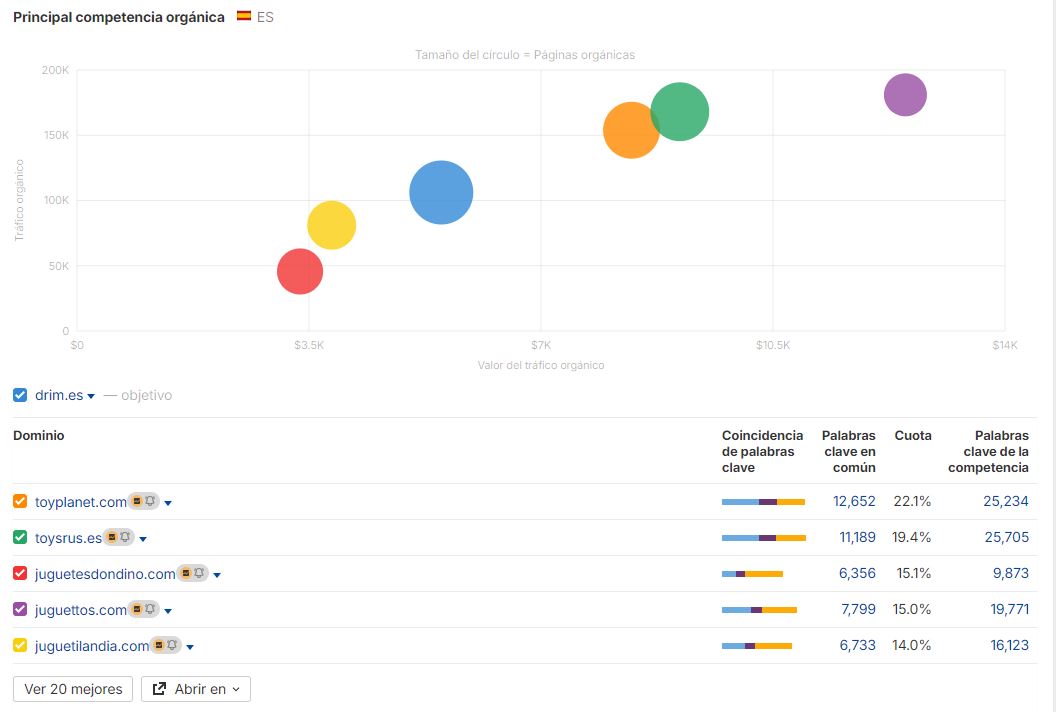
This chart is one of Ahrefs' most prized. It shows us at a glance who we compete with and what situation we are in. OJO does this based on the keywords positioned by us, and looks at the domains that share the most keywords with ours. This view is useful because if we see that the websites that appear to us are not our real competition, we have a big problem: we are positioning for concepts outside our business. This may seem very Martian to you, it is more common than you think, I have seen it hundreds of times. A client comes to you saying that they have a lot of organic traffic but that they don't have customers. That they have an SEO agency that they are great and that they write a lot of articles on the blog. That's wonderful, but they're writing about things that don't bring you business. And the most serious thing, that they place you semantically and in front of Google along with other types of websites. In your blog you should talk about what is closely related to your business and what worries your potential customers and that may lead them to hire you. Nothing more.
But back to the graph: in the rounds we see our situation against others. On the abscissa axis (horizontal) it estimates the value of traffic, and on the ordinate axis (vertical) the volume of organic traffic. For the client we are analyzing, it is in a central and centered position, in balance. What worries me about your case is that you have the largest circle (keywords ranked), but three of your competitors have more traffic and more value from it. Ifkeywords per kilo are never the solution. You should focus on improving the rankings of specific keywords that attract a lot of traffic and sales, rather than ranking for new things.
In the rows we see keyword matching, and here there is often a lot of opportunity. The ones marked in blue are the competition and we don't (we call this keyword gap), the lilacs we have in common, and the orange ones are positioned by us, but they don't. You must keep in mind that searches for your brand are not going to be pursued by them (although there are those who do). But well, the fun here is that this helps you detect if we are being competitive in the shared keywords, and if some of the ones they rank for interest you in the future.
Competitor analysis
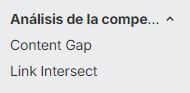
At the top left we find an extension of this info. We can add the domains we want to investigate, and it will give us positioning opportunities and much more:
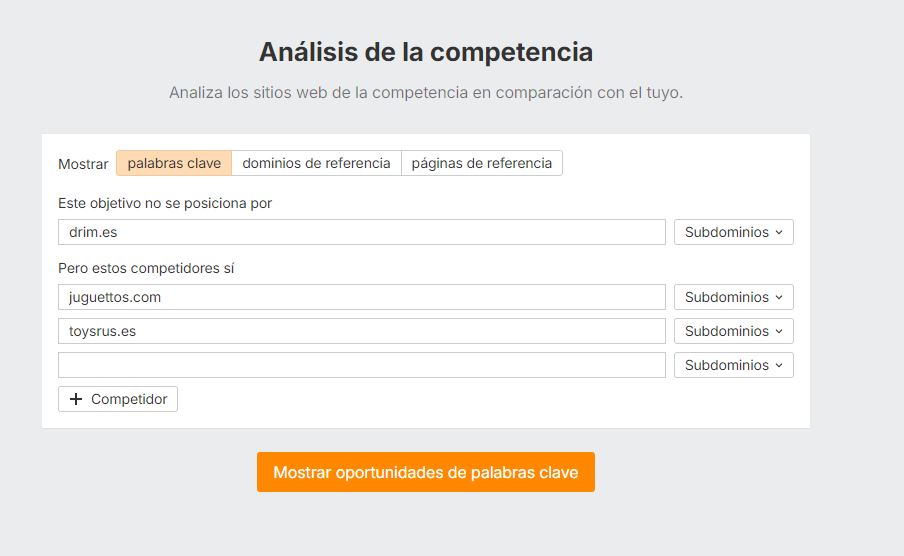
The results are a mine of information that can open our eyes or make our heads explode. For now we are going to see keywords that they are positioning and we are not. If they have volume and we are interested in it at the business level, it should be a priority to put a trump card there:
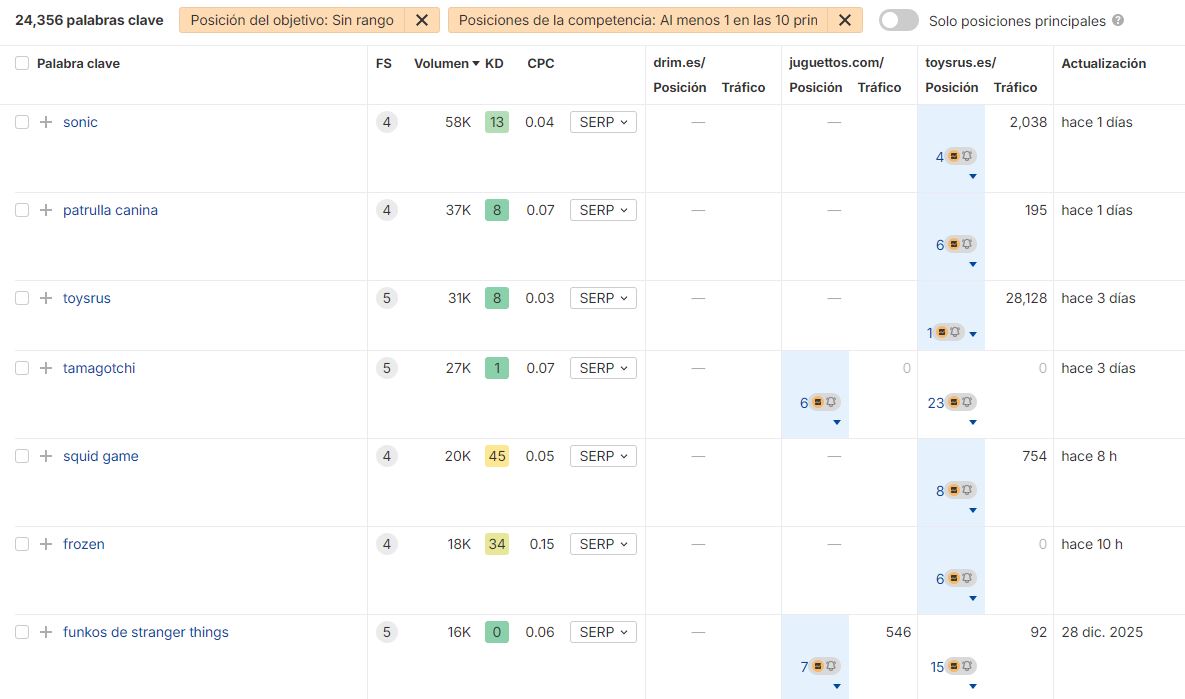
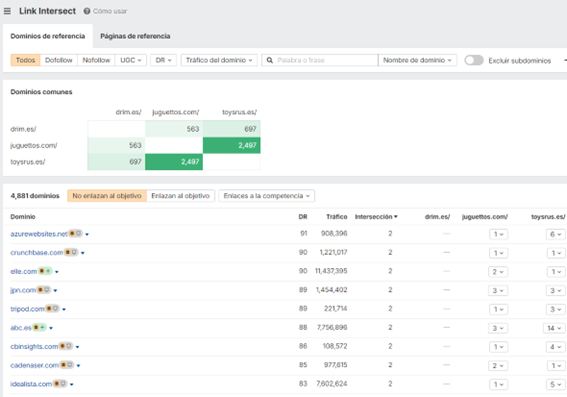
This was in terms of keywords ranked. But we have a new tab, the Link Intersect, which is going to tell us what incoming links they have that we don't. Ordered by DR, in addition. There you have a cool list of websites to contact for possible collaborations, and if they have already done so, why not us?
Top organic keywords
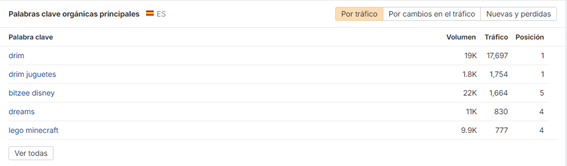
There is no more secret to this, the Keywords that bring you more traffic. We will see it in more detail through this little button to see all. But it already gives us a first idea. Here what we see in the applied case is that two keywords are from our own brand, one is our own brand but misspelled or perhaps they are fighting for their dreams. Now it's a little late, but this wouldn't be a perfect entry-level name for a new business, as it's not clear. If you are at this point, we recommend our post on "Checklist: what to take into account for the naming of a digital business”. The really interesting thing about this first view for the customer is that two of its main keywords are from other brands that it sells (Disney and Lego), but for which OJO is far from the first position. On his list of priorities, he would put at number one to improve those two keywords, as they are already attracting a lot of traffic, and if we advance a position, the short-term gain in clicks is brutal. To the mess.
Top organic pages
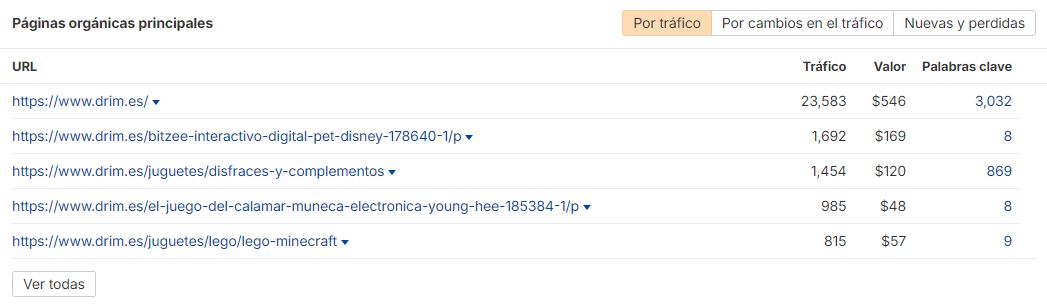
This is the other side of the same coin. This time we see the URLs that are reporting the most traffic, and they will usually be related to the previous words. In the applied case we see that we have the home page (searches for our brand), two specific products, a category and a collection of a specific brand. Here the merchant's job would be, on the one hand, to check the destination URLs with fire: that everything is on their site, that the star products are available and we have stock for a while, or that what interests us most appears first in the listings. If you think these things go beyond SEO, you're wrong. You always have to go one step further and have the business first, always.
Organic pages by traffic
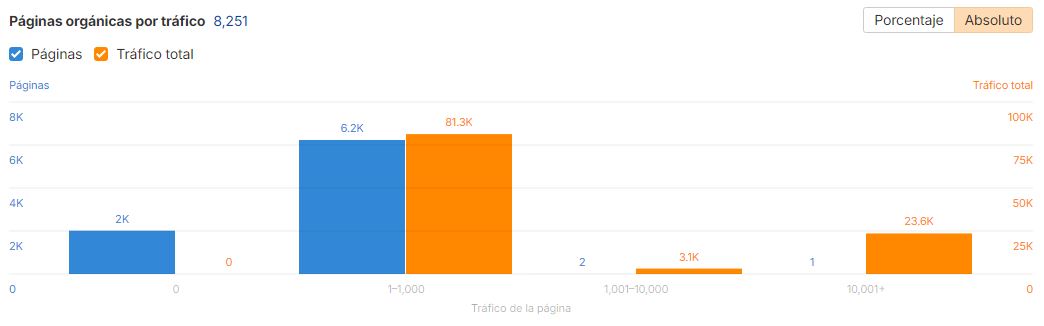
Come on, we are already in the last section of Site Explorer, a few years ago there were three things and today it is very complete and only with this page we already get a lot of information about our domain and others.
In this case we see how distributed our traffic capture is between pages: how many pages do not attract traffic, how many provide some clicks, and those that attract the most. It can give us an idea of whether we have a more or less balanced site, or it can warn us that we need a good pruning. One thing to watch out for: not every page on a website aims to capture SEO traffic, and not all of them can do it in the same way. But if we have a large percentage of URLs that don't bring traffic, it's to make them look at it, because it's a nice waste of crawl budget.
Going back to the example you see in the graph: we have more than 2,000 pages that do not bring SEO traffic, we may be interested in improving or eliminating them. Then we have many pages, 6,000, which attract some traffic (selection and to enhance some). But we also observed only two pages that attract a lot of traffic and one that attracts a lot (the homepage). This is very unbalanced and there is an excessive dependence on two urls that can be unstable, so I would put a candle to ensure that those two do not fall, and then I would draw up a plan for a wider group of urls to gain strength, to ensure the stability of traffic in the medium term.
AI Content Helper
A tool with a lot of room for improvement, which aims to use AI to improve the positioning of content in relation to the target keyword. This is only worth noting if we already have a url and we want to improve it. We must provide as much information as possible, as you will see in the image: what keyword I want to promote, what is the URL of my project that I want to position, we indicate the country, we mark the brand kit if we have it configured, and very importantly, the urls of the competition (usually the first 5 organic results).
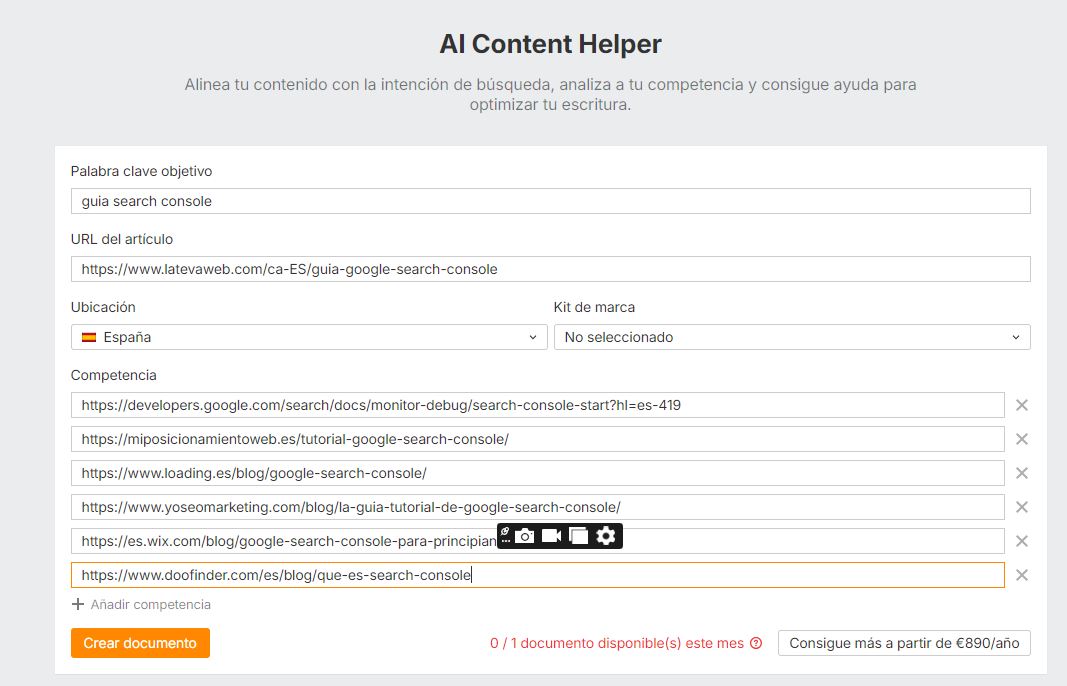
The next thing we must do is provide them with our content, either by importing with the functionality we have, or by copying and pasting. It will analyze us and we will obtain a score and a series of suggestions for improvement:
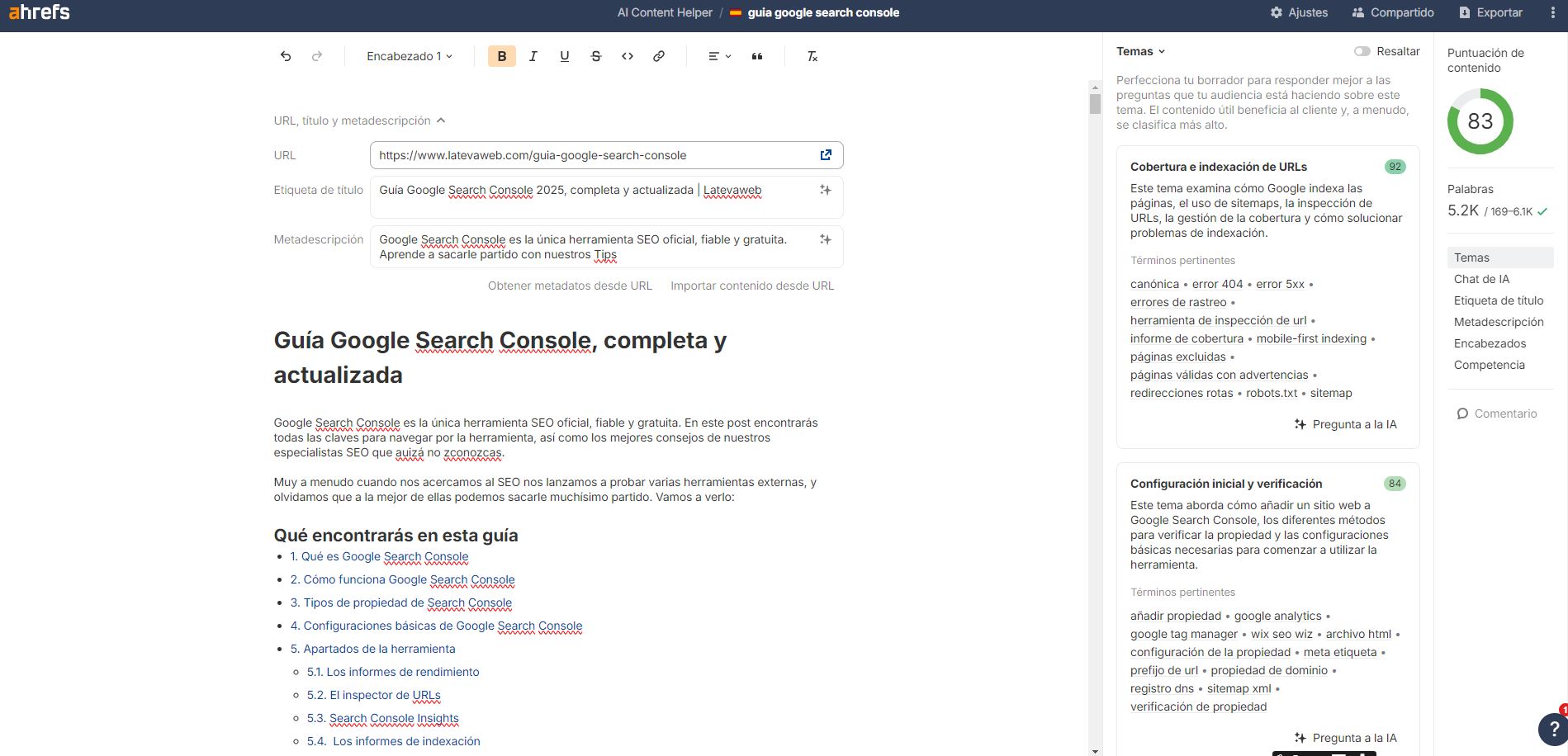
You have the post structured by the topics, and for each subtopic you get detailed analysis and suggestions. We also have an AI chat, to which we can ask specific queries:
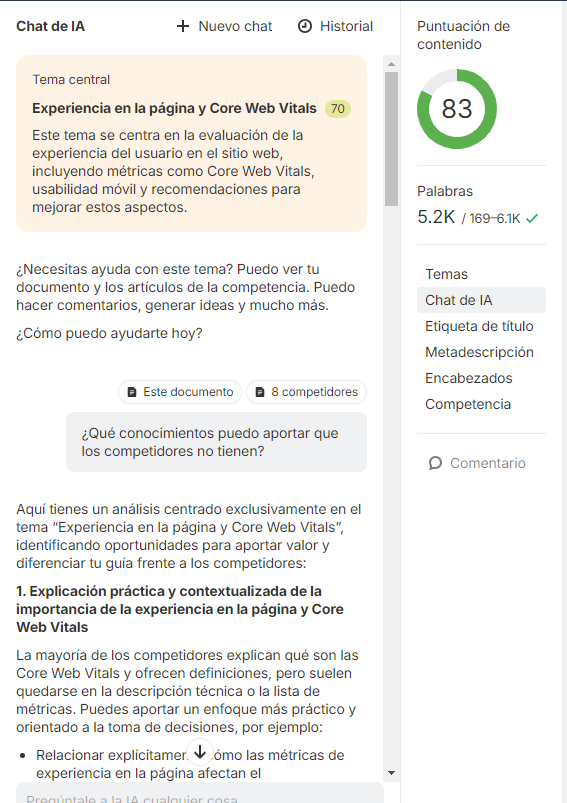
We have very specific sections on how to optimize the title, meta description, headings, or an analysis of the content of each of our competitors. Very complete but also very entertaining, only advisable for projects with time to dedicate, which must already be mature and for keywords and main urls, or you will die trying.
Keywords Explorer
This is a very powerful tool for conducting keyword research. Its most common use is to obtain from a generic keyword, its derivatives and relationships.
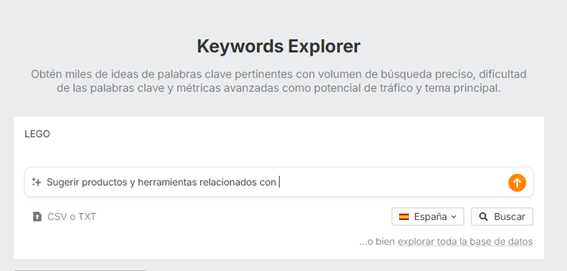
In this case I propose a keyword that we have seen had business intention and we did not have a bad positioning, LEGO. In addition, with its AI tool there is a battery of prompts that we can use or we can create our own. For the occasion I ask you to suggest related products and tools, and language mark. We seek to chase our luck:
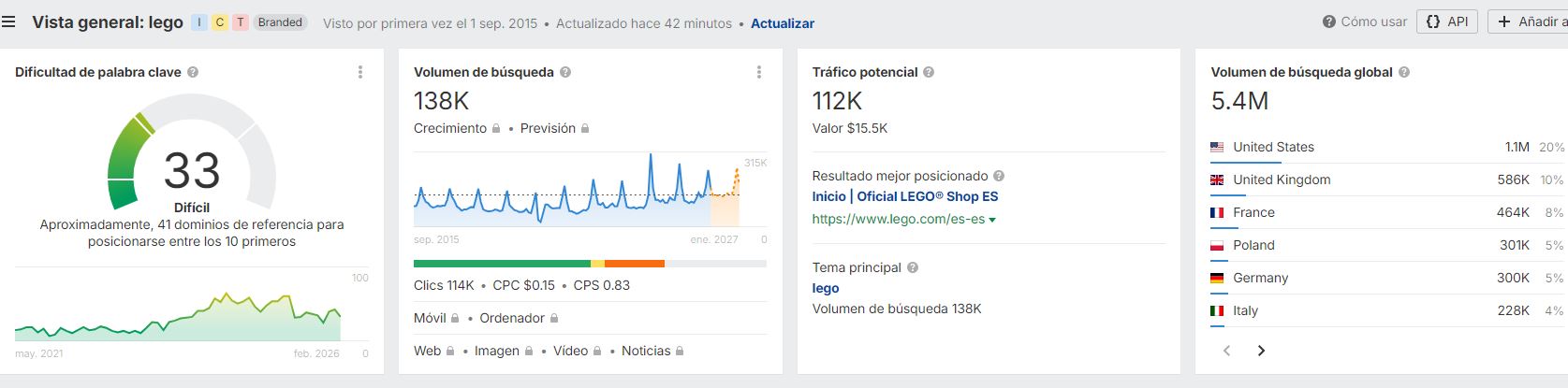
The first thing we are going to see is detailed information about this strict word: its search intent, the difficulty of positioning, the expected CPC in Google Ads, its evolution over time and possible seasonality, potential traffic, and its international demand. Very powerful to know if it is worth fighting for. To assess it, identify: how much you are interested in it at a business level, where we are today, what is its difficulty... and choose your battles.
Keyword ideas

Our basic keyword is related to an infinite number of concepts. These are grouped into 4 columns, which can be interesting at different times in the study:
- Term matching: searches that contain our keyword, and then some. Typologies, derivatives, models, etc. Sorted by volume. They can give you ideas to optimize the main URL or even for the generation of new ones
- Questions: Detects question-type search formats. You may be interested in structuring some of the target information content, or to incorporate a thematic FAQ page. This will allow us to be eligible in the usual queries (People Also Ask), or in the answers of ChatGPT and other assistants.
- He also positions himself for: their relationship is a bit spurious, but it could be useful to us. Here we see concepts that rank domains that also rank for the keyword we're researching. In the end they could be entities or concepts from the universe to work with. We won't always be interested, but maybe it will.
- He also talks about: here what we see are concepts that are often used in the specific URL that ranks for the keyword (not the domain). There's a good chance you'll be interested in using those concepts on your landing page.
Position History
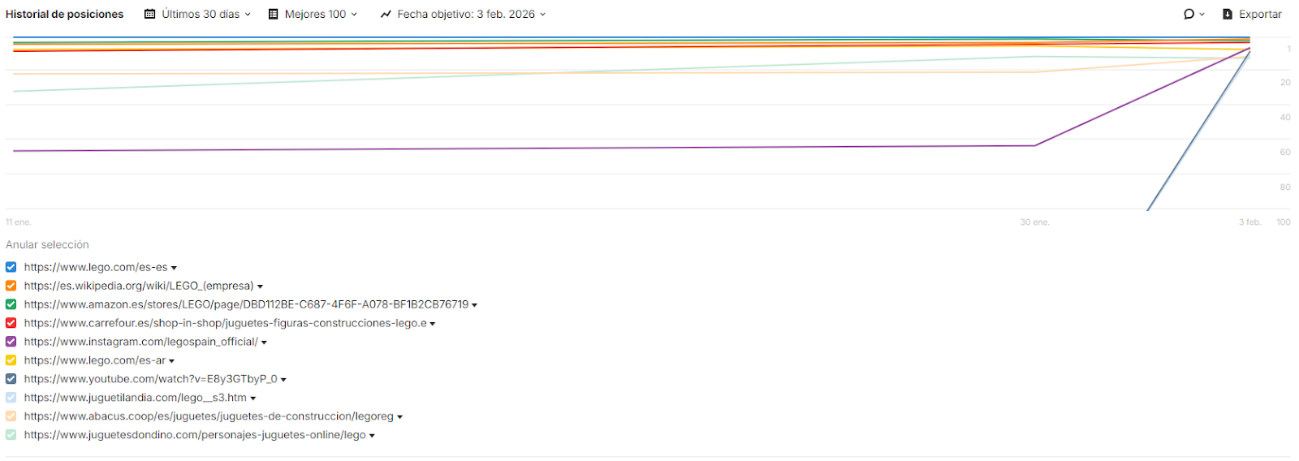
In this graph we see the 10 best positioned URLs for this keyword and their evolution over time. By default we will have the last 30 days, but we can go further. If we look at the example results, we could point to the customer a few things that we do see:
- two URLs are from the manufacturer, which is normal
- two URLs are from social networks, something related to a recent Google algorithm change. We may be interested in talking about this product on our networks, or even if we have a good business relationship, negotiate a campaign or joint publication with the manufacturer
- two marketplace URLs: if you can't beat your enemy, join them. We can recommend our client to analyze the feasibility of being present in marketplaces such as Amazon or Carrefour, in this case.
- 3 URLs are from competitors, and some have gained relevance in recent weeks. Here the way would be to analyze what they are doing well at the level of On Page SEO, internal and external linking, and apply what is viable, natural and safe in our project
SERP Overview
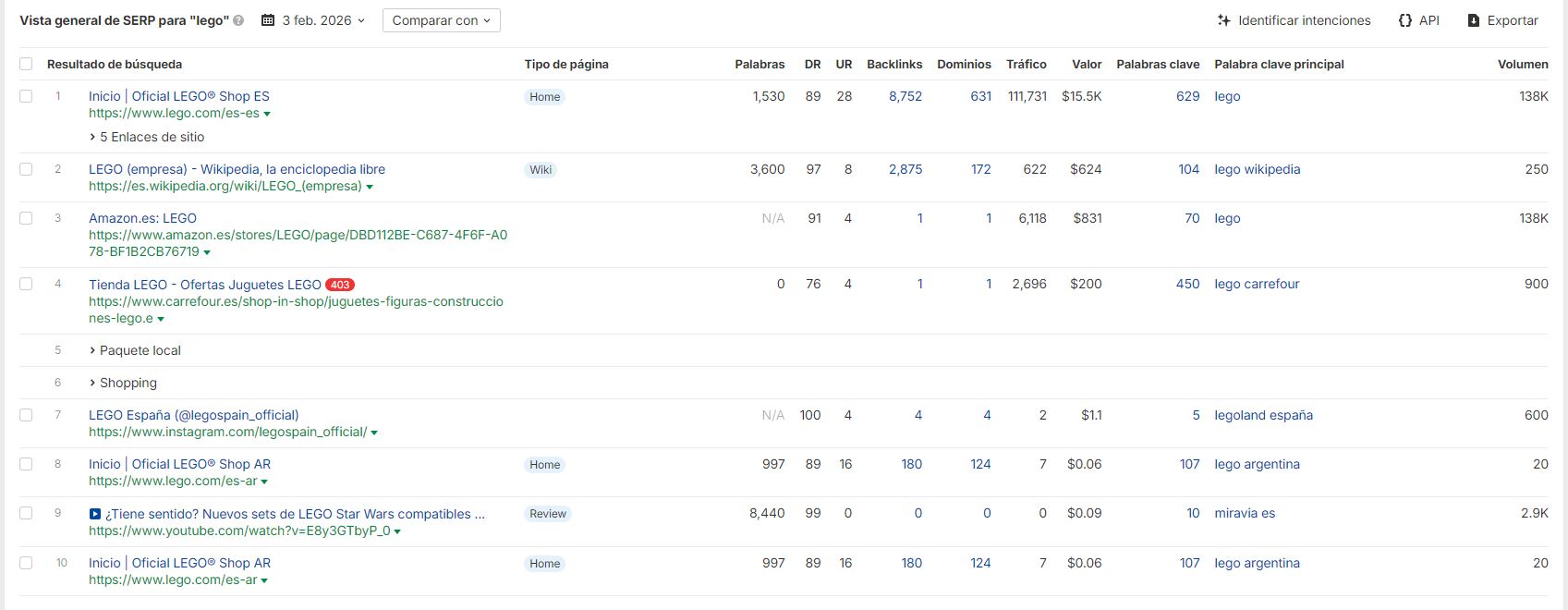
This would be an extraction from the SERP results when we search for the concept. That you could do it yourself, but you may be contaminated and here it will give you extra information. For example, it tells us the type of snippets we find in the search results, and there you can turn on a little light. From the example we see we could extract two ideas: 1) We will be interested in being present in the local SEO results: mention the brand in our Google Business Profile service catalog, or in the profile description, or create a thematic publication if we have any news or promotion about this brand; 2) we must rank with products in organic Google Shopping, and if we can and we have a margin, we also have a margin.
Content Explorer
This tool can be used for two main topics: to give you ideas for topics to be dealt with in a certain vertical, or quality link building opportunities. You could use it as a Google Trends, but you'll see that it's so much more. Let's imagine that I want to work on aspects of my GEO hub, let's see:
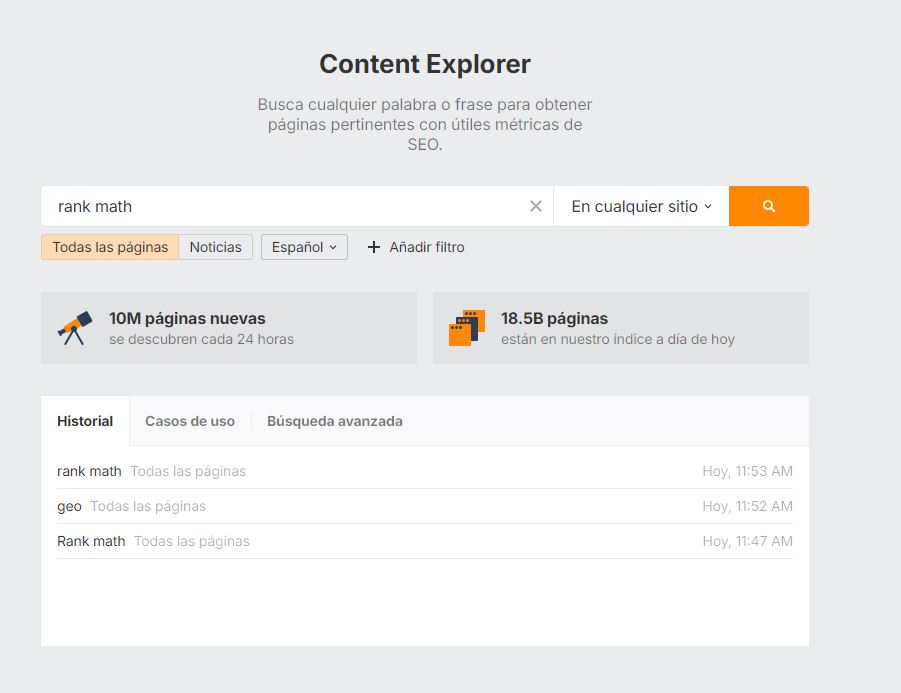
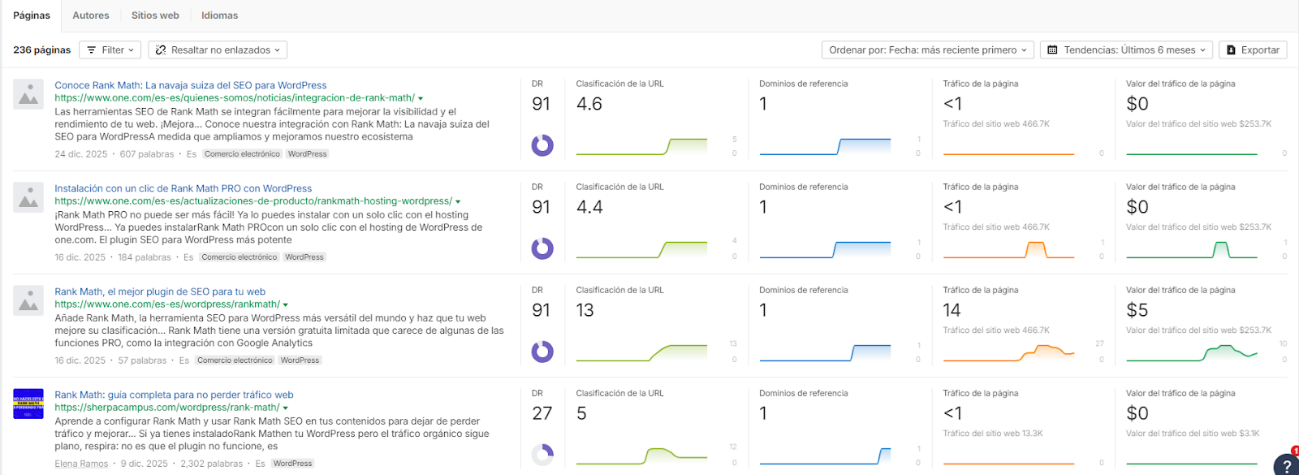
I indicate the topic, and for now we filter by language and little else. Here we will begin to see results, and you must filter for your taste and need at all times. I think it is a very powerful tool at the level of link building, very surgical, but it needs advanced configuration. Take a look at the example: we searched for topics related to the SEO Rank Math tool, filtering by language. Then we have ordered it for freshness. Well, we have found some interesting content due to its DR, which we could take advantage of in many ways.
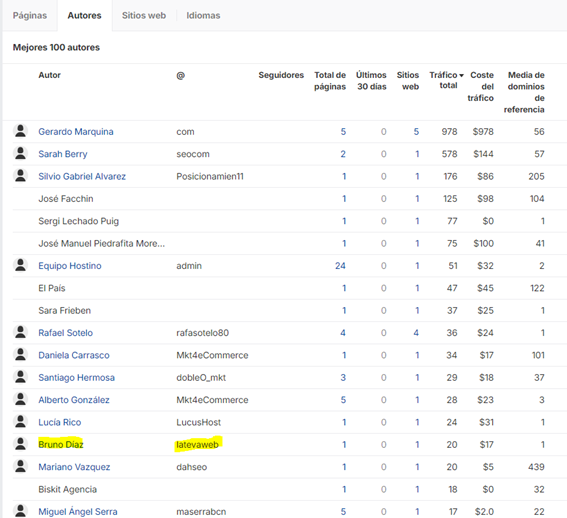
Another dimension of the tool is the authors part. It's powerful to see if our authors are relevant to a certain topic, but it could also be interesting if you're looking for collaborations or guest authors for your blog: well, hey, I'm going to see who is a reference on this topic, I'm going to see what they've published, where and we've already made decisions. We wanted to investigate the topic "SEO for AI":
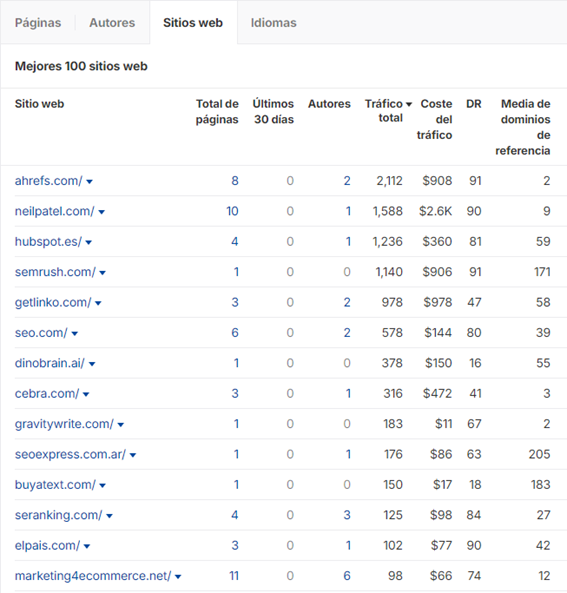
Another approach is from websites: which domains are publishing the most on this topic? What volume? Filter to your liking depending on whether you are looking for quantity or quality, and you shape it. To explore collaborations or a campaign, I think it's a pretty TOP utility:
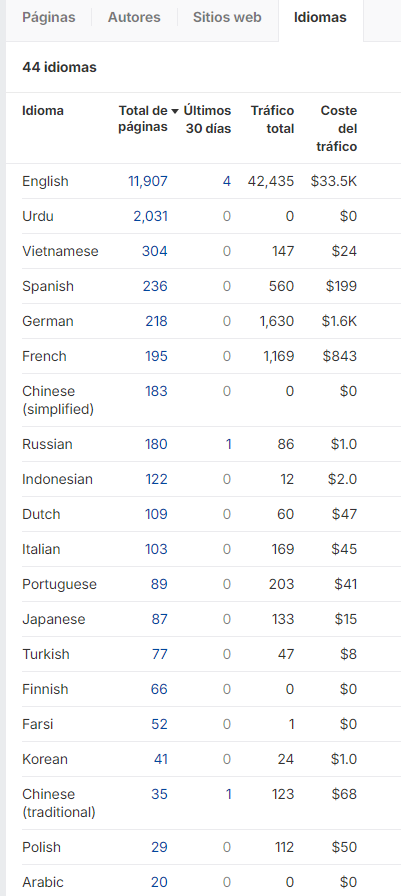
Finally, the tool has a language section. In which language is the most being published on a topic? It may interest us to detect trends or opportunities. Going back to Rank Math, we see that a lot is published in English (normal in the sector) and in Urdu (predictable due to the origin of the platform), and we observe that Spanish is already the fourth language on these topics. Well, look, maybe it's an interesting topic to work on, as there seems to be a notable demand. It is also true that, based on these numbers, if we generate new content on these topics, it may be interesting to provide an English language version.
SEO Audit with Ahrefs
To be able to audit a website with the tool, we must first create a project. And if we want to create a project, we have two paths: if we have access to Search Console, it is the short and most recommended path, because it will take data from there, more reliable, and all the history. If you prefer to have more control, manually add:
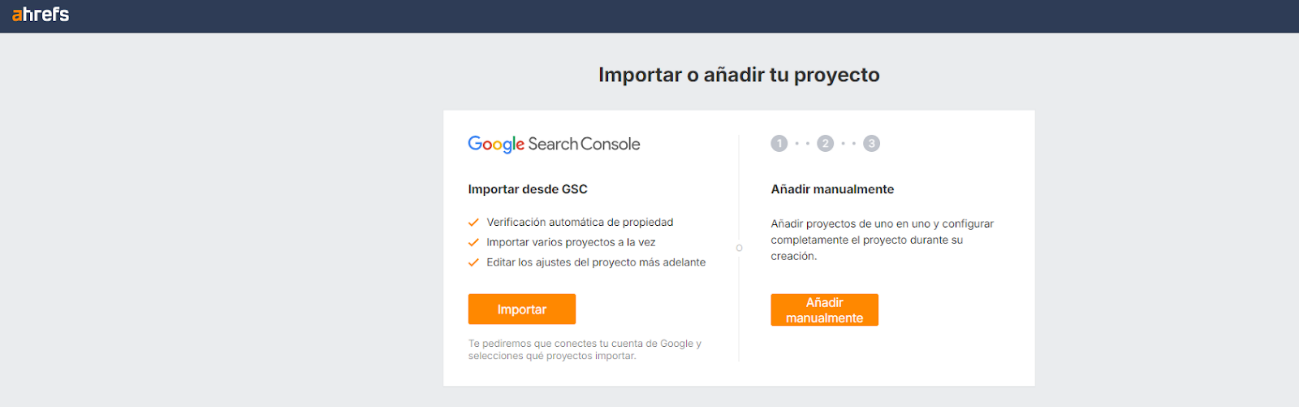
To create it, we advise you to configure at least:
- Basic Property Facts
- Keywords to rank for (will activate your Rang Tracker)
- Website audit settings (scope, periodicity)
- Competitor websites
In this way, the resulting audit will be done with context and intention, if not, it will make an impeccable technical audit but without taking into account what we are pursuing at the SEO level. Up to you.
Ahrefs has probably the most powerful SEO audit among SaaS SEO tools. In my opinion it's almost as complete as Screaming Frog's, but it's also online and more visual, especially if you want to export data, take screenshots or present something to the client.
Overview
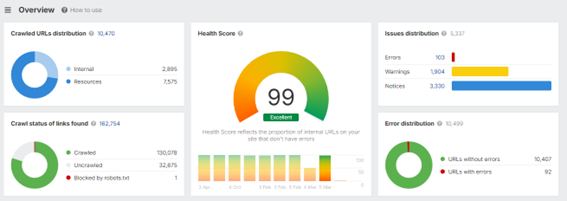
This would be the manna of SEO audits. It takes a lot to get a 99 out of 100 in Ahrefs eh, but be careful, the numbers should not obsess us, this is a very worked project and I have a bit of OCD. Even in many projects it will not be worth taking it here, and with a remarkable one we will be pulling.
In any case, we are interested in the overview of:
- Crawled URLs distribution: to see what type of URLs the creature has crawled the most (internal, external, or resources). From the example we do not have external audits (normal, it's an internal audit isn't it?), but the relevant thing is that it has consumed a lot of crawl budget in the crawl. Now think about whether that interests you that to happen to Google too, in some projects the answer will be yes, in others no
- Health Score: let's classify what this scoring means. This is actually the % of website URLs analyzed that are error-free (serious stuff). The larger the site, as it is a percentage theme, the more controllable and stable its distribution will be. Look at the example that if we have also carried out several audits on the project or even if we have scheduled an audit every X amount of time (highly recommended), we will see its evolution.
- Issues distribution: Ahrefs, like practically all SEO tools, detects the things we can improve on our website and tags them based on their importance (severe, moderate, mild)
- Crawl status of links found: this is already a high level and very relative. But well, what it tells us here is: I've found so many links. And of these found, I have tracked this percentage (crawled), I have not tracked this other one because you have indicated it to me in the project configuration (uncrawled), and you block it to Google (Blocked by robots.txt)
- Error distribution: this view is interesting because it allows us to see how concentrated or distributed the errors found on our website are. It's a relief when we see it green, because we know that working on a small group of URLs, the impact will be great. There is also the option of loading those URLs, but I leave it to your consideration.
What’s new
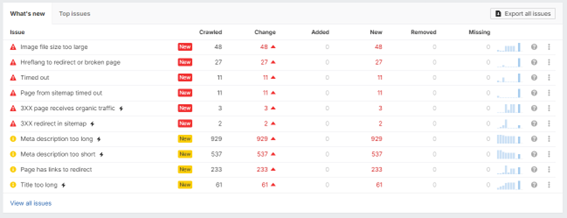
Then in What's new we will find the most recent errors, something only relevant for projects that have follow-up. It is interesting for large sites or those in which several actors are making changes, to see if there are new errors in the last few days because they have messed me up with something. The example I have given you indicates that some images that weigh a lot have been uploaded, some hreflangs towards broken pages and so on. You can review them one by one, we will see the details of the affected URLs, and we can export it wherever we want.
Top issues
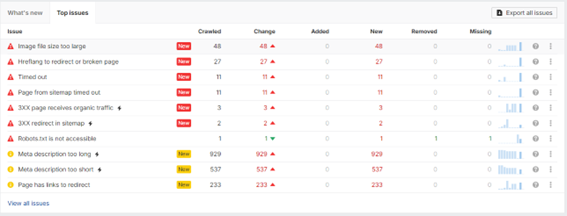
For TOP issues here what prevails is the importance of the errors and not the novelty. It is more useful for projects with little follow-up or with entrenched issues that there is no way to solve. In any case, severity should be a determining factor when it comes to filtering priorities. But you must set the gravity, the tool will only suggest it to you. It can also give some false positives due to problems in Ahrefs tracking, which you can adjust over time.
HTTP status codes distribution
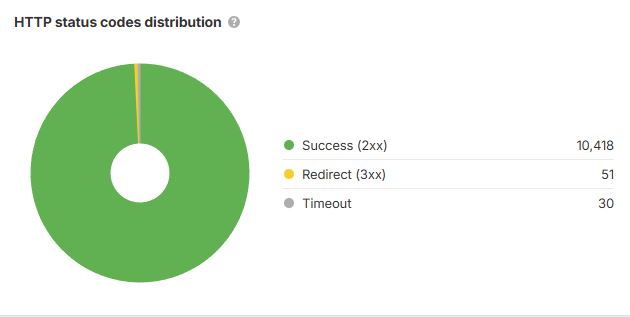
The HTTP codes will give us indications of which server response has given Hrefs the query to certain URLs. The ideal scenario is that all URLs give Success 2xx, which means that the page works and is available. We must avoid at all costs having 4xx and 5xx errors on our site. And well the issue of the 3xx: it is true that the ideal is not to have internal redirects, but if they are of small proportion as you see in the example, then it is not a drama either. If you want to spin fine, then you can get the list to replace them. What I do find relevant at least is that you pass that group of redirected URLs through Screaming Frog or another tool that helps you determine where they redirect. Because they can redirect to a broken page or one that we are not interested in. Detecting redirect loops and avoiding 301 = > 404 seems more relevant to me than not leaving 3xx to 0.
AI content level distribution
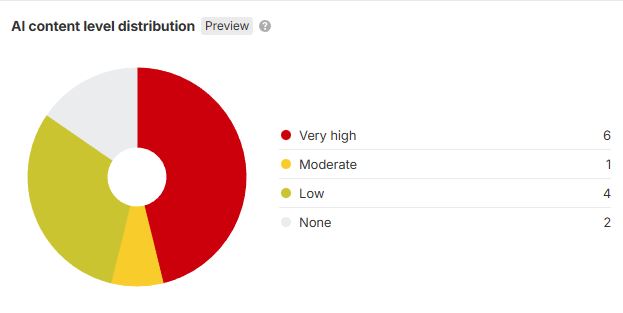
What this new toy does is detect pages with suspiciously AI-written content. Like other detectors in the industry, it has moderate reliability. Here my suggestion is that you take a sample and read the content. The first and fundamental thing is that the content is fine, whether it was written by an AI or my aunt from Albacete. But the affected pages most likely contain structures, taglines, or even watermarks that clearly reveal poorly targeted or revised AI writing.
Bulk report
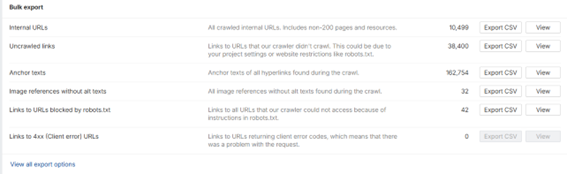
This is wonderful if you like to immerse yourself in the data, be able to export it, present it, send it, etc. You'll see that it suggests tables to export, but the options are endless.
The audit has many more sections and I cannot dwell on it any longer, in any case realize that we are facing a tool of enormous potential if it is well managed. If not, beautiful graphics and an entertaining waste of time.
About the author
Bruno Díaz — Marketing Manager
Professional with a long career as a communication and digital marketing consultant, specializing in SEO, SEM and web projects. As Marketing Manager of the agency, I coordinate a great team of digital marketing technicians of which I am very proud.
Related news


Hello! drop us a line