


20 / 02 / 2024
How to internationalize your digital business

Bruno Díaz
—Marketing Manager
SectorLet's talk about
Many companies question the viability of expanding their presence into new markets. The growing digitalisation opens up endless possibilities to accelerate and reduce the costs of these landings. But it is not as simple as it may seem. In this post we have tried to identify the steps we should follow to analyse and implement the internationalisation of our website, whether corporate, informational or an online store. We provide this methodology after helping, as a international SEO Agency, dozens of clients to gain international presence and success, while also assisting many international clients to open their market here. Obviously, it should be adapted to each case, but it can serve as a starting point:
Table of Contents:
1. Situation analysis
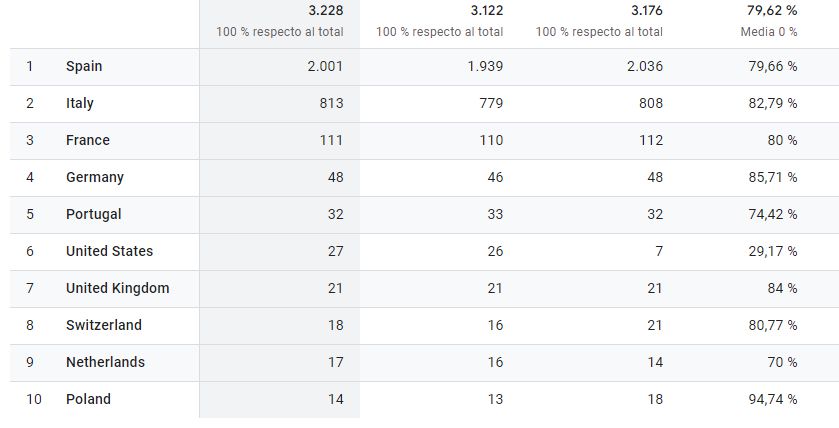
We must analyse whether we already have a market opportunity among our audience. Analyse your Google Analytics to detect: visits from X countries, by browser language, or cross-referencing both.
The key here is to detect:
- from which countries those visitors are arriving
- which content they are consuming (informational, navigational, transactional)
- how they behave on the website (bounce rate, retention time, pages viewed, conversion rate, etc.)
- Can we offer our products and services in those countries? If so, would we be competitive?
2. Market research
Who are we going to target? These are the scenarios:
- Multilingual: my website is in different languages, regardless of user origin
- Multiregional: I offer content based on the country or region where the user is located
- Hybrid: a combination of the above. We may have a website for various countries, and within them, we offer content in several languages
Each scenario must be adapted to the business needs and available resources, as we have ordered them from lower to higher required resources.
Next, we will conduct a brief keyword research for interesting languages or countries. It is not about doing an exhaustive analysis that delays the project excessively, but rather enough to decide whether there is “water in the pool” before diving in. You can use a keyword research tool to detect search volumes and search patterns.
3. Translate website
Here we have several options:
- Automatic translation: we can translate our content using tools such as Google Translate, Deepl or ChatGPT, among others.
- Amateur translation: ideally using internal company resources, we can assign the translations to someone who knows the product/service/company and masters the target language. It may not be flawless, but it will be well aligned with the industry.
- Professional translation: hiring a professional translation agency. The translation will likely be impeccable, but you must consider the costs.
You may also opt for a hybrid model, such as an automatic or amateur translation followed by a professional review.
In some cases, what we may need is not a translation, but creating new content, especially when cultural or service-related differences require it.
4. Customer service
If we are going to offer services to certain countries and languages, we must provide support in those languages: replying to emails, WhatsApps, chats, or phone calls (preferably with their prefix). If you lack internal resources, you can hire an external company. We must define which channels we will enable and how we will support those users in their language.
5. Market research
Here we should indeed conduct in-depth keyword research. A starting point could be translating the keywords from our original-language website, but that will not always work and we could be missing a lot of market. A more interesting approach is analysing the leading websites in those countries, detecting both organic and paid search patterns (that’s where transactional intent lies). In addition to regular SEO keyword tools, here you can use Google Ads’ planner or even its internationalisation tool Global Market Finder. And there is a key aspect to consider when working on international SEO: seasonality and timing in purchase decisions differ greatly between countries.

6. Launch
This is where we make this new website or part of it public. It is essential that before going public the site is reviewed by someone fluent in that language, familiar with the country, knowledgeable about the industry or potential customer. We must ensure that for that audience our proposal is clear, attractive and as personalised as possible. And appear as local as possible: using adapted copy, with their expressions, enabling the preferred contact methods, popular payment methods, or even patriotic or folkloric elements. We must BUILD TRUST.
If you don’t see a full launch clearly, or lack resources, we can make a partial test launch: for example, publishing a simple landing page for that market, sending Ads traffic to it, and validating before a full rollout.
7. SEM
SEO is the best channel when done well, but it is long-term. In a digital business launch, the recommended approach is to activate a Google Ads, Meta Ads or any suitable SEM platform campaign at the same time as the website goes live. This campaign allows us to validate whether the keywords and target audiences are appropriate and whether the landing page converts for that audience.
8. SEO
We will not go deep here, as we already have an extensive international SEO guide available. If we want to work on international SEO we must make very good decisions and implement aspects such as: hosting, domains/folders/subdomains, hreflang, CDN, etc. With all this we can cover a good SEO setup, but we cannot stop there: we need a roadmap for each country, addressing technical SEO, content, brand building and more.
9. Brand awareness
Obviously, when landing internationally, we are unknown as a brand or even as a service/product in that market. You need a brand strategy if your plan is long term. We need visibility and to generate brand searches.
10. Diversify channels
All the previous steps refer to working on our website and owned channels. But nowadays that may not be enough. Marketplaces, directories and large portals dominate much of the search landscape.
11. My brand vs competitors
Once we are up and running, we must take it further. Keep competitors monitored:
- SEO tracking
- Linkbuilding
- SEM analysis
- Price comparison
12. Advanced international SEO aspects
Important elements:
- Search engines
- Domains
- Brand registration
- Language selector
- Avoid mixing languages
- Image SEO
- Google Merchant
- Google Business Profile
13. Other aspects
Additional considerations:
- Naming
- Legal aspects
- Shipping
About the author
Bruno Díaz — Marketing Manager
Professional with a long career as a communication and digital marketing consultant, specializing in SEO, SEM and web projects. As Marketing Manager of the agency, I coordinate a great team of digital marketing technicians of which I am very proud.
Related news

Hello! drop us a line
The growing digitalization opens up endless possibilities to accelerate and reduce the cost of these market entries.